
Welcome to OSV Field Notes, a weekly, high-signal curation of things worth your time.
This week: what happens when you look a little closer. A wrong number uncovers half a million photographs and an unlikely friendship, Candice Millard finds fresh ground in one of history’s most overexamined lives, John Steinbeck explains how to finish a book by forgetting the book, a baby forces her father to rethink what makes a good children’s story, and Hitchcock turns the simple act of watching into suspense.
1. A Wrong Number, a Half-Million Slides, and a Real-Life Walter Mitty

Have you ever wondered who had your phone number before you? Lauren Stevens found out. When her new work phone started receiving calls and texts for someone named “Verndawg,” she and her friends did some online sleuthing. It didn’t take long. The intended recipient was Wernher Krutein, a 72-year-old San Francisco photographer who has spent six decades documenting the world through a camera lens — bugs, buildings, people, landscapes, everything — and archiving it all into a collection of more than 500,000 individually cataloged film slides. Stevens calls him a real-life Walter Mitty.
The archive isn’t just huge. Krutein built his own system to keep track of it. He invented a cataloging method he calls Fluid Logic, in which every single slide is stamped with a unique code, tagged with location and date, and wired into a digital database containing over three million search terms. The system allows him to locate any image from his life’s work almost instantly. He built Photovault.com in the late 1990s to house it all digitally, and the site remains a staggering artifact — part stock photo archive, part one-man encyclopedia of the visual world. One of his best-known images, a car dangling from the collapsed Bay Bridge during the 1989 Loma Prieta earthquake, has appeared in textbooks and documentaries for decades.
When Stevens got to know him, Krutein was barely making a living. He lived alone in Sonoma County with no heat in the house, no family safety net, and savings he measured in months. Stevens launched a GoFundMe, created the Instagram account Verndawgtales to share his work and their story, and became what she describes as his adopted granddaughter. A wrong number turned into one of the most genuine friendships I’ve seen online.
Start with this video and try not to hit the follow button. [Taylor]
🌐 Verndawgtales on Instagram
2. Hero of the Empire : The Escape That Made Winston Churchill

Like the Lakers with Kobe and Shaq, or the Bulls with Michael Jordan and Scottie Pippen, some rare dynasties earn a three-peat. The Field Notes version of those triumphs belongs to Candice Millard, the only author I have recommended three times.
I’ve praised her work on Theodore Roosevelt and James Garfield. But her highest dive may have been the book on Winston Churchill. Why? Because the world’s bookshelves groan under the weight of Churchill books. Worse still, he was a gifted writer himself, and his pen was as energetic as the rest of him. Take on a Churchill book and you’re competing against the man, the myth, and thousands of volumes, many of them canonical.
Millard took it on anyway and came out with something remarkable in Hero of the Empire. She found the story that had been underexplored: Winston as a young man in South Africa, twenty-four years old, hungry for a war record that would launch a political career. He went out as a newspaper correspondent and was captured by the Boers when they ambushed the armored train he was accompanying. He escaped in Pretoria, with no map, no compass, and no Afrikaans, then made his way nearly three hundred miles toward safety in Portuguese East Africa, hopping trains and hiding for a time in a coal mine. The Boers put a price on his head. He came home a national hero and was elected to Parliament within a year.
This is one of those moments in Churchill’s life where history turns on a few inches. During the ambush, he stood exposed on the tracks for the better part of an hour under fire, and later wrote that a bullet passed close enough that he felt certain he should have been killed. Millard tells it with her gift for the adrenaline-pounding scene.
Churchill is a complicated figure, of course. But there’s something bold in what Millard did here: take one of the most exhaustively chronicled lives in history, find a story still worth telling, and take a fresh angle on it. [Jimmy]
📙 Hero of the Empire by Candice Millard
3. John Steinbeck’s Best Writing Advice: Forget the Book
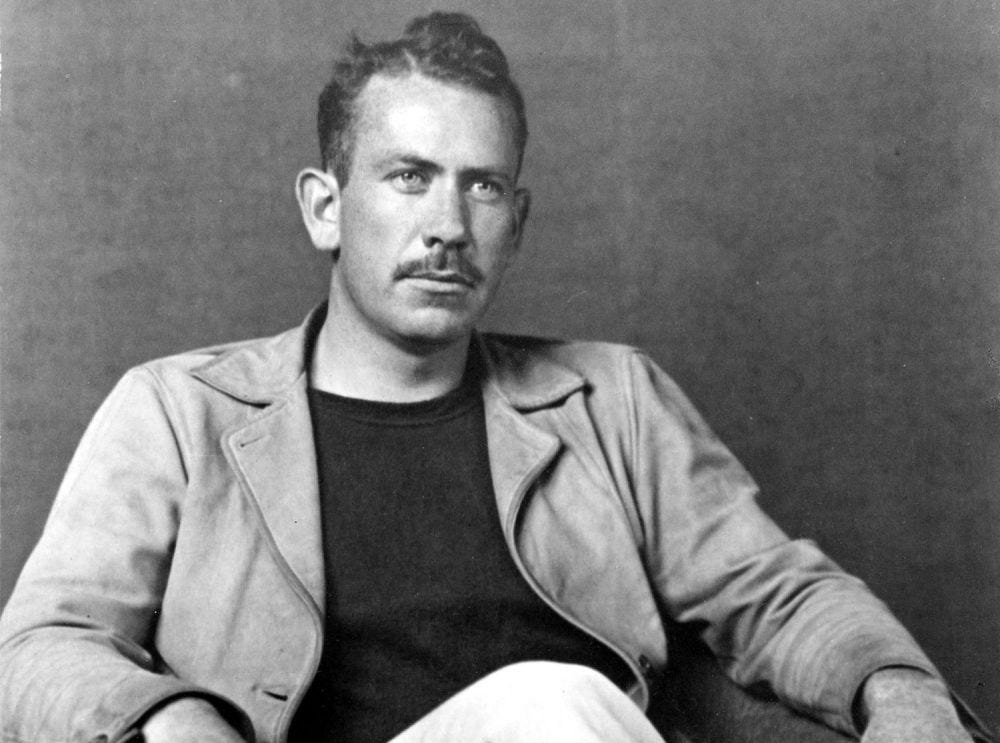
I’ve read dozens of books on writing, and ninety-nine percent of them fail in two pretty important ways: (1) they lack any insight into writing, and (2) they themselves are badly written. The only real wisdom I’ve found has been in the Writers at Work interviews published by Paris Review, and of those interviews one stands out: John Steinbeck’s. He actually died before he could give the interview, but the magazine stitched it together posthumously from his East of Eden diaries and personal letters. Maybe that’s why it’s so good. It’s honest.
In this pseudo-interview, Steinbeck lays out six rules (which are actually from a letter to his friend, Robert Wallsten, who was stuck on a novel of his own). The first rule, aptly enough, is the best:
“Abandon the idea that you are ever going to finish. Lose track of the 400 pages and write just one page for each day, it helps. Then when it gets finished, you are always surprised.”
The book is not the problem. The idea of the book is the problem. It’s much like mountaineering. The difference between a heavenly ascent and a hellish one is your eyeline; if you’re constantly staring at the summit, the climb will take forever. You’ve got to forget the summit even exists. That’s how you reach it.
Steinbeck won the Nobel eight months after sending that letter, just so you know. [Dylan]
📄 John Steinbeck, The Art of Fiction No. 45 (The Paris Review)
4. Tales from Acorn Wood : Baby Books Parents Can Enjoy Too

If you don’t have a child somewhere between 0 and 3, you can skip today’s recommendation (unless you just love reading books designed for babies, in which case each to their own, I suppose).
Over the first few months of my daughter’s life, we worked our way through much of the Baby Literary Canon, everything from The Very Hungry Caterpillar (greedy bastard!) to Hairy Maclary from Donaldson’s Dairy (my GOAT).
As far as reading went, these were the halcyon days. The little one didn’t know me from Adam, nor a book from a spoon, so the whole exercise was pretty much entirely for my benefit. In hindsight, I may as well have been reading her a James Ellroy novel.
Anyway, at around 10 months, something shocking happened. She began to engage. This, plus her newfound ability to use her hands and to scream at us the moment she gets bored with a page, led to a dramatic shift in our reading material. Gone were the wry humour of Oi, Frog! and the magical realism of The Tiger Who Came to Tea, replaced by a single-minded fixation on any book that pops or flaps or squeaks or otherwise delights her senses.
The touch-feely, poppy-outty book industry has realised something clever. As long as their books have some physical element for a baby to fiddle with, they don’t need to worry about pesky, time-consuming concepts like language or story or art. So our reading took a turn for the worse. It is, of course, delightful to see the surprise on my daughter’s face every time Olly the Octopus shakes his little tentacles at her, but from an adult reader’s perspective there’s only so much to gain from such books as Pop Up Peekaboo! and That’s Not My Badger.
Which brings me, finally, to today’s recommendation, which I will keep mercifully short.
You may be familiar with the insanely prolific children’s author Julia Donaldson. Everyone’s heard of The Gruffalo and Room on the Broom. We’ll get to those in a couple of years. For now, the Donaldson du jour is her series Tales from Acorn Wood, illustrated by Axel Scheffler. It is the perfect series for our literary predicament.
Set in a whimsical woodland filled with anthropomorphic animals like the wise Doctor Stoat, the always-tired Rabbit and the hapless Frog, these books (we own seven out of eleven) are the only ones in our collection that unfailingly delight us all. For baby: charming illustrations and, crucially, flaps on every page, each hiding some fun little detail. For parents: a simple and amusing story, told in Donaldson’s delightful rhyming musical style. [Ed]
📚 Tales from Acorn Wood by Julia Donaldson
5. Rear Window : The Thriller Where All You Can Do Is Watch
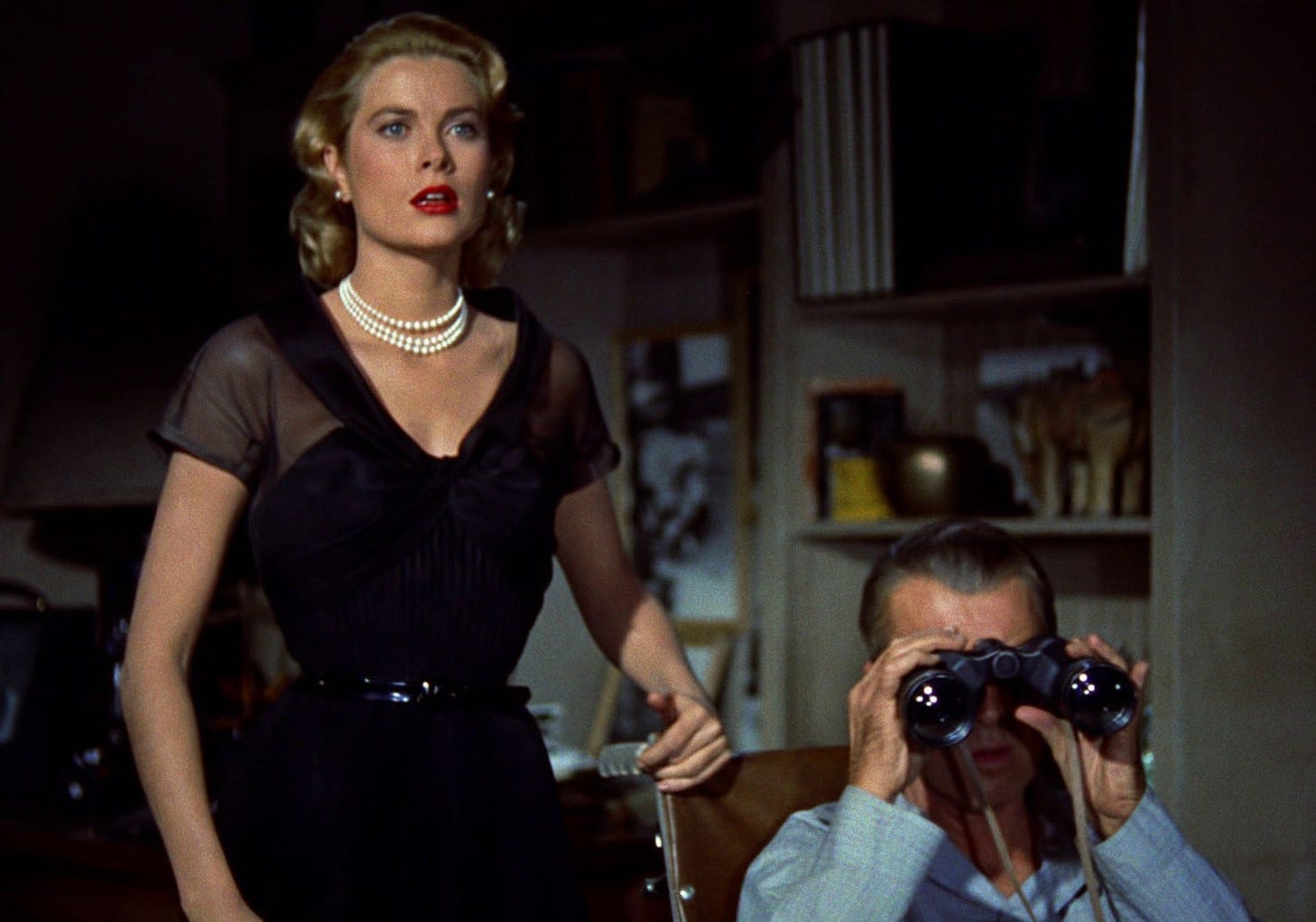
I watched Alfred Hitchcock’s Rear Window for the first time a few days ago with my family. Except, in a way, I already knew it. I grew up on The Simpsons, and season 6 has “Bart of Darkness,” where Bart breaks his leg, gets a telescope, starts spying on the neighbors, and becomes convinced that Ned Flanders murdered his wife. Only years later did I realize this was an homage to Rear Window.
It came out in 1954, so I won’t be as careful as I normally would be with spoilers. Jimmy Stewart plays L.B. “Jeff” Jefferies, a globe-trotting photojournalist stuck in his apartment with a broken leg.
Hitchcock takes away the one thing thriller protagonists are supposed to do: move. Jeff can’t chase anyone, sneak into buildings, or investigate much of anything himself. All he can do is look out the window at the neighbors across the courtyard.
Hitchcock had the whole courtyard constructed on an enormous Paramount soundstage: 31 apartments, many of them fully furnished. From Jeff’s window, they become little screens, each with its own story playing out.
Jeff spends much of the movie doubting that his girlfriend Lisa could fit into his adventurous life. Then she crosses the courtyard to do the investigating he can’t, and ends up in danger. Jeff is stuck in his chair, and so are we. We can see what’s happening across the courtyard, but all we can do is watch. [Liberty]
🎬 Rear Window (1954, Alfred Hitchcock)
⭐ Explore the OSV Field Notes Archive ⭐
Enjoyed OSV Field Notes? 💌 Forward it to a friend!

I need to read more Candice Millard 🤔