
Welcome to OSV Field Notes, a weekly, high-signal curation of things worth your time.
This week: the ticking watch inside Dunkirk, a food insider who reads the fine print, a defense secretary explaining the unthinkable, the tiny carvings that survived a family’s dispossession, and a break from serious things with swords and sorcery.
1. Dunkirk : The Sound of Time Running Out

Dunkirk is Christopher Nolan’s account of the evacuation of the British Expeditionary Force from the beaches of France in 1940. It came out back in 2017, and you may remember the hype when it debuted. This is a film that lives up to it.
Some 400,000 Allied soldiers were hemmed in against the sea by the German army. The evacuation that followed, codenamed Operation Dynamo, relied on naval ships and an armada of little boats: fishing vessels, pleasure craft, lifeboats, ferries. The evacuation succeeded beyond anyone’s wildest expectations. Churchill had guessed they might save 30,000; more than 338,000 made it home.
What sets Dunkirk apart from most other war movies is its structure. The evacuation took place over nine days, but Nolan presents it as three interwoven storylines: events on the beach (a week), on the sea (a day), and in the air (an hour). They run side by side throughout the film, converging only near the end. Nolan’s purpose is to depict what it was like to be caught up in it, whether as one of the soldiers waiting on the sand for rescue, one of the pilots flying Spitfires against the Luftwaffe, or one of the captains, professional and amateur, navigating their ships and boats into the teeth of enemy fire to ferry as many frightened young men off that beach as possible.
The evacuation succeeded because thousands upon thousands of servicemen and ordinary Englishmen and women did extraordinary things: they went out on the water in their own boats, manned guns alongside soldiers they’d never met, flew combat missions. Nolan gives us a sense of what it was like to be on the receiving end of such heroism. He shot much of the movie on IMAX cameras, with real Spitfires and as many as a thousand extras on the beach at a time. There’s very little dialogue; the emphasis is on Hans Zimmer’s score (built around the ticking of Nolan’s own pocket watch, audible throughout) and on the sounds of war: exploding shells, anti-aircraft fire, machine guns.
You won’t find it in a theater anymore, so find the biggest screen and the loudest speakers you can. It’s a triumph of filmmaking, and worth every one of its minutes. [Jimmy]
🎬 Dunkirk (2017), directed by Christopher Nolan
2. Flip the Label

If you’ve ever driven I-35 through Ames, Iowa, you’ve passed a massive Barilla plant. That blue box of spaghetti with the Italian flag energy? It’s filled in Iowa with durum wheat from the northern plains. The side of the box says so — most people just never flip it over.
That’s the premise behind The Food Manufacturing Guy, an anonymous food manufacturing insider who goes by @TipOfTheBanana on X. His newsletter tears down one grocery product each week, from what the label says to how the plant makes it. The headline from his Nutella breakdown is that your jar is only 13% hazelnuts. The rest is mostly sugar and palm oil. His argument is that the ratio comes down to how many hazelnuts Ferrero can buy. By his estimate, the company already buys about a quarter of the world’s crop.
His career has been spent inside food plants — sourcing, formulation, FDA and USDA compliance — and he writes with the authority of someone who knows exactly which claims on a package are marketing and which are legally required to be true. A cream cheese deep dive explains that the brick meets a federal cream cheese standard (at least 33% milkfat and no more than 55% moisture) while that standard doesn’t apply to the tub labeled “spread” — one word removes the floor. He stays anonymous because, as he’s said, he still makes food for a living.
We spend more time choosing a Netflix show than reading the ingredients and product information of the food we are dumping into our bodies. The Food Manufacturing Guy makes that back label the most interesting thing in your kitchen? Follow him, then go flip a label. [Taylor]
3. The Fog of War : How It Made Sense at the Time
It’s unnerving to have former U.S. defense secretary Robert McNamara looking you in the eye while he explains his part in firebombing Tokyo.
Errol Morris built a machine to make that possible. His Interrotron is a modified teleprompter that puts the interviewer’s live face in front of the camera lens. It sounds like a small thing, but it feels very different from watching someone talk to an interviewer off to the side.
In The Fog of War (2003), the secretary of defense under JFK and LBJ tries to explain decisions whose consequences are almost impossible to comprehend. He’s articulate and very good at explaining himself, but how much can you trust him?
One of the hardest things to realize is how much intelligence and effort can go into doing terrible things. McNamara describes analyzing B-29 bombing runs against Japan. Flying higher made the crews safer, but it also made the bombing less accurate. Decades later, he recognizes the horror of what he helped do, but can still explain why those decisions seemed defensible at the time.
How much credit do you give a man for understanding, decades later, what he helped do? [Liberty]
🎬 The Fog of War (2003), directed by Errol Morris
4. The Hare with Amber Eyes : A Family History in 264 Carvings

Edmund de Waal, a British potter, inherited 264 Japanese carvings that had belonged to his great-uncle Iggie in Tokyo. They are called netsuke, meaning tiny hand carvings that were used to hang pouches from a kimono sash. Because traditional Japanese kimonos had no pockets, people suspended things like pipe cases or pill boxes from silk cords behind their waist sash. And a netsuke was attached to the cord ends to act as a counterweight to keep the hanging items, also called sagemono, from slipping.
One of the netsuke that Edmund received was a hare with amber eyes, which prompted him to pen a memoir with the same name. He started searching for the history of these items and who had possessed them before they came into his great-uncle’s hands. The story starts in 1870s Paris with Charles Ephrussi, an art collector from the wealthy European Jewish banking dynasty and peer of the Rothschild family. He had sent the netsuke to his cousin in Vienna as a wedding present, which then ended up in a dressing room, where the children used to open the glass cases and play with them.
In 1938, the Nazis seized the family’s palace and looted its collections. According to the family’s account, Anna, a maid at Palais Ephrussi, hid the carvings in a mattress. After the war, the collection survived through generations of war and displacement.
I found it like a memory book with a lot of names inside it, which may be because de Waal is a ceramicist. In 2021, 100,000 copies were distributed for free in Vienna. The idea of the smallest pieces of inheritance surviving generations felt fascinating to me and for that, it was an interesting read. [Aashisha]
📘 The Hare with Amber Eyes (2010) by Edmund de Waal
5. Swords Against Darkness : A Pulp Fantasy Festival Lineup
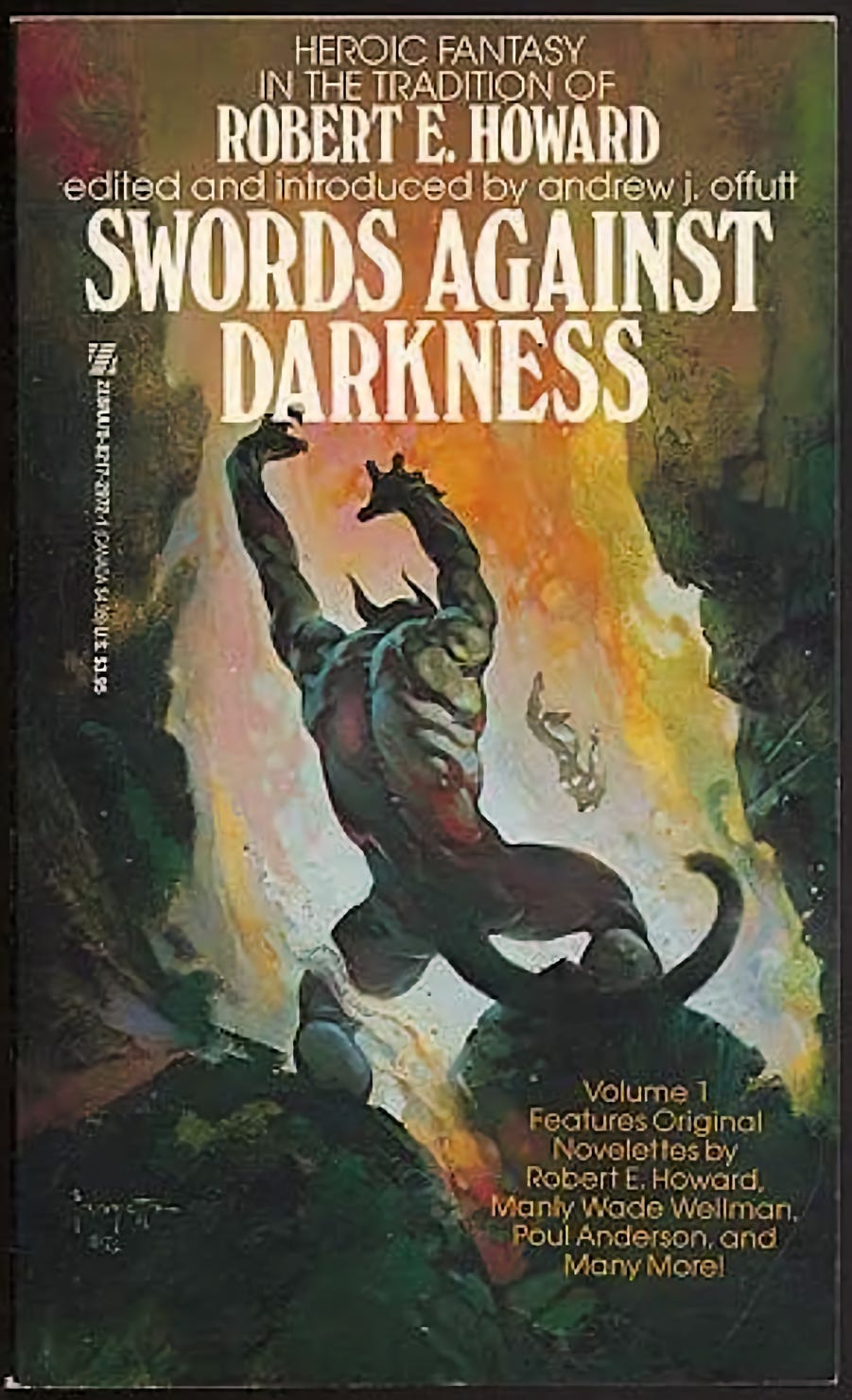
Every music festival has artists from different tiers: promising young talent, heavy-hitting players with songs everybody knows, headliners that make you buy the ticket, and maybe a legend or two that you want to see because you never know if they’ll tour again.
Have you ever wondered what that would look like for writers?
Well, let me introduce you to Swords Against Darkness. It’s a pulp fantasy anthology series featuring some of the genre’s biggest names, edited by Andrew J. Offutt.
You may or may not know the name Robert E. Howard, but you definitely have heard of Conan the Barbarian, which he created. He “headlines” this collection with Nekht Semerkeht, a story he started and Offutt completed. Other established writers include Manly Wade Wellman and Poul Anderson.
I’ll warn you: these are not high literature, or even high fantasy. These stories shine by scratching the itch for quick, rough-and-tumble adventure tales featuring a singular bold hero battling villains, monsters and demons from Viking-age Scandinavia and the haunted Roman frontier to Atlantis and alien planets.
These writers weren’t winning Pulitzers*, but they were stirring the imaginations of young and old for decades.
The trick is finding them. For the later volumes, try eBay or used bookstores. You can try the first volume on Kindle to see if it’s the sort of collection you’d like to add to your library.
When you need a break from all the serious and important things you do in your day, consider a highly-curated pulp fantasy tale from Swords Against Darkness.
Sci-Fi more your thing? The closest comparable anthology I’ve found for Sci-Fi is the Dangerous Visions series Harlan Ellison started. Its volumes are all either in print or available in e-book.
Happy Reading! [Jameson]
*To be fair, Baen’s profile of Manly Wade Wellman says his Civil War history Rebel Boast was nominated for a Pulitzer.
⭐ Explore the OSV Field Notes Archive ⭐
Enjoyed OSV Field Notes? 💌 Forward it to a friend!
