
Welcome to OSV Field Notes, a weekly, high-signal curation of things worth your time.
This week: Side doors into worlds you might otherwise miss. A cinema through a peephole, a Soviet spy becoming a little too American, chess after the board finally starts making sense, a film that nearly disappeared, and Mozart through the ears of the man who envied him most.
1. Peepholes, Backrooms, and the Smallest Screens in America
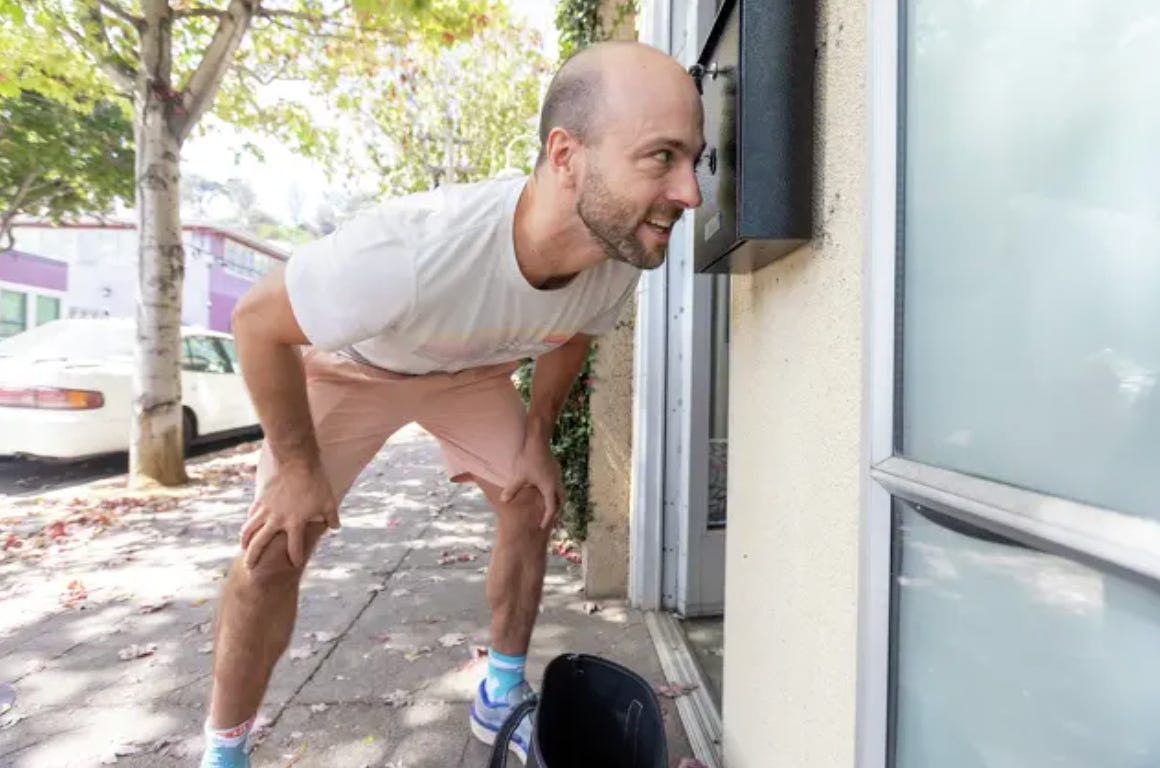
In 2013, an animator named Laurie O’Brien drilled a hole in the exterior wall of her home in San Francisco’s Mission District, mounted a tiny screen behind it, and started playing silent films 24 hours a day. No sign. No admission. Just a dime-sized peephole in an alley that rewarded anyone curious enough to crouch down and look. She called it Peephole Cinema. When O’Brien eventually moved to Brooklyn, she brought the concept with her — opening a second peephole at 97 Wilson Avenue in Bushwick, behind a door labeled “Mr. Manual Wilson, Bureau of Deacceleration.” The original SF location went dark during COVID but reopened in 2025.
Now the idea is multiplying. SFGate reports that Sam Goldstein and Glenn Black are building custom-made hole-in-the-wall TVs — Glenn engineered a CAD-modeled, 3D-printed peephole system — and working to expand them across San Francisco. These whimsical moving picture projects are a fun way of creating a treasure hunt that allows people to explore neighborhoods in new, analog ways.
But the peephole is just the most charming expression of a broader movement: Micro-cinemas. These single-screen venues with fewer than 40 seats, often tucked inside bookstores, coffee shops, and video stores are booming in New York, proliferating across Los Angeles (where Vidiots’ 36-seat MUBI Microcinema and a VHS backroom in Echo Park called Whammy! are leading the charge), and IndieWire declared last year the dawn of a “golden age of microcinemas.” I once had a film screen at a festival in a tiny town along the Mississippi River in Wisconsin, where the local micro-cinema called itself the “Minema” — a name I still love.
What connects all of this is something older than cinema itself: the desire to gather a small group of people in a dark room and show them something worth seeing. Before multiplexes, before streaming, before algorithms decided what played next, there was just a screen and an audience. The micro-cinema trend brings us all back to that. In a world that keeps making screens smaller and more private, these spaces insist on making them communal again — even if the theater only seats a few. [Taylor]
2. The Americans : When the Cover Starts Becoming Real

Actor Matthew Rhys is fresh off a historic night at the Emmys, winning two lead-acting awards in the same night, so it seems fitting to recommend the earlier show that first exposed me to him: The Americans, in which he stars alongside his longtime partner Keri Russell. I never understood why this show didn’t have a bigger following, or maybe it did and I just came to it late. I think it’s fantastically rendered, and it draws a portrait of spy life and the Cold War that is too often overlooked.
Russell and Rhys play Elizabeth and Philip Jennings, deep-cover KGB agents the Soviets called “illegals.” They are operatives inserted into a foreign country with fabricated biographies, no diplomatic protection if caught, and no way home. The Jennings run a travel agency in suburban Virginia. They raise two children who initially have no idea of their parents’ double lives. They run missions for their handlers by night, and an FBI counterintelligence agent lives across the street. The show has all the gripping spy business you’d expect, but what it really shows is how difficult that double life becomes. Their characters have to become Americans, and what is appealing about America can’t help but seep through.
In one of the show’s best threads, Philip starts attending EST seminars, the self-help movement that swept the country in the 1970s and 80s, and you watch him begin to chafe against the Soviet restrictions he grew up with. He enjoys American life and freedom. And it is fascinating to watch him wrestle with that against the mission he and his wife have sworn to uphold.
The show deserves a wider audience. It is two enormously talented actors at their very best, and a spy story where the cover gradually becomes part of the person. [Jimmy]
📺 The Americans (2013-2018)
3. There’s Never Been a Better Time to Learn ‘The Game of Kings’

You may be thinking, “Am I really being told to learn chess on a media newsletter?”
Yes. Yes you are.
If you’ve already studied the game, then consider this your reminder to start playing more. For those who have never attempted to understand chess’s beautiful complexity, I’m begging you to give it a shot.
The real reason is the feeling you get when you finally start putting it all together.
The tingle you feel when you see checkmate in three moves for the first time is electric. The smugness you have to hide when an opponent takes your bait of a sacrificed rook... there are a thousand different ways you will feel excitement when you realize you are playing with strategy instead of moving blindly.
It’s been the best way for me to exercise my brain and I’m actually getting better!
The good news is that there are free and easy ways to learn the game in bite-sized pieces.
Did you know Duolingo has chess lessons? That’s where I started for most of this year. Then I discovered Chess.com, which also has free lessons and daily puzzles that have helped teach me actual tactics to use on the board.
Then, when you’ve got a tiny sense of how to think through a game, start playing strangers on the internet. That’s where the real thrill lies. In the arena. You will get smoked many times, but that’s ok. The losses only make the first win feel that much more valuable.
You could study for 5 minutes a day and find out you’re better than any of your friends in less time than you’d think. Sudoku and crosswords are fine, but nothing stimulates my mind like head-to-head combat on an 8x8 grid. [Jameson]
4. The Fall : The Film No One Could Find

Legendary film critic Roger Ebert gave it four stars and said one might want to see it for no other reason than because it exists. For years, the problem was actually finding a way to watch it. The Fall premiered at TIFF in 2006 and received a limited theatrical release in 2008, but after its licensing deals expired it vanished. In 2024, eighteen years after the premiere, MUBI finally brought it back with a 4K restoration.
Director and producer Tarsem Singh shot the film across 24 countries and took 4 years to make it, largely financing it himself. The story is set in silent-era Los Angeles where Roy, a paralyzed stuntman, tells an elaborate fantasy to a six-year-old girl named Alexandria to manipulate her into stealing morphine for him. The places where the film was shot (with minimal CGI) included Rajasthan’s Chand Baori stepwell, Jodhpur’s blue city, Namibia, Bali, Fiji, Prague and other stunning places. One of the interesting parts was when Roy says “Indian,” meaning a Native American from a cowboy film, while Alexandria pictures a South Asian worker from her orange groves back home.
Catinca Untaru, who played Alexandria, was an actual six-year-old Romanian girl who had never acted before. She didn’t speak English when filming began, so she learned her lines phonetically. In fact, she was led to believe that Lee Pace, the actor who played Roy, was actually paralyzed. Talk about being in character.
The film can be slow in places but I believe certain stories need a degree of leisure for the effects to sink in. This was one of those. Even though the film made $3.7 million against a $30 million budget (some did call it self-indulgent), I found the story was a character of its own. That, for me, is a redeeming act. [Aashisha]
🎬 The Fall (2006)
5. Amadeus : Imagine Competing With Mozart

I recently rewatched one of my favorite films, Amadeus (1984), with my kids. It was their first time and my... fourth? I lost track.
The movie is really Antonio Salieri’s story. Mozart says at one point, “I’m a vulgar man. But I assure you, my music is not.” That’s basically Salieri’s problem in one line. He’s a successful composer himself, and he has enough musical taste to recognize that this giggling, childish, vulgar guy is producing something he never could. He can hate Mozart all he wants, but every time he hears the music, he knows.
One of my favorite scenes is when Salieri remembers hearing Mozart’s Gran Partita for the first time. He walks us through it: a low pulse from bassoons and basset horns, then an oboe above it, then a clarinet takes over. And while he describes what’s happening, we hear exactly what he hears. F. Murray Abraham is incredible in the role. The guy who hates Mozart is also the guy teaching us why Mozart’s music is so good.
Watching Amadeus when I was younger sent me exploring Mozart and other composers. I hope it does the same for my kids.
The story began as a 1979 play by Peter Shaffer, who also wrote the screenplay for Miloš Forman’s film. Shaffer wasn’t trying to write a biopic and took some pretty big liberties with history. There’s no evidence Salieri tried to murder Mozart, and while they may have been rivals, they weren’t mortal enemies. They even collaborated on a piece. But Shaffer used the two composers to tell a story about talent, genius, envy, and a man who decides to pick a fight with God.
The other scene I love is near the end, when a dying Mozart dictates part of the Requiem to Salieri. Mozart is hearing the whole thing in his head and throwing out one part after another. A half-delirious Mozart is composing faster than Salieri can get it onto paper. [Liberty]
🎬 Amadeus (1984)
⭐ Explore the OSV Field Notes Archive ⭐
Enjoyed OSV Field Notes? 💌 Forward it to a friend!
