
Welcome to OSV Field Notes, a weekly, high-signal curation of things worth your time.
This week: things reveal another layer when you look closer. An AI town that starts developing a social life, Star Wars with the mythology stripped away, words for feelings that were already there, the classical music inside Billy Joel, and movie theaters that turn out to be community infrastructure.
1. Smallville: What Happens When 25 AI Agents Live Together

I’m three years late, but the “Smallville paper” is incredibly cool.
In 2023, researchers from Stanford and Google published “Generative Agents: Interactive Simulacra of Human Behavior.” The paper describes fusing large language models with interactive agents to produce believable simulations of human behavior.
These ‘generative agents’ are designed to behave like believable people, drawing on ideas from cognitive science. The architecture has three main pieces: a memory stream that stores each agent’s experiences, a system of reflection that synthesizes those memories into higher-level conclusions, and a planning module that uses all this information to decide what to do in the current environment.
And to visualize it all, they put 25 of these agents in a small 2D sandbox environment, inspired by games like The Sims. They named this tiny town “Smallville.” Give one resident the idea of throwing a Valentine’s Day party, and the news starts spreading: agents invite each other, make new acquaintances, ask each other on dates, and eventually coordinate to show up at the party. Incredible.
As GPT-6 launched on September 3, my timeline was filled with people building all sorts of interesting toy prototypes in Blender and other game engines. I was reminded of this paper and finally read through it all.
The footnotes are the best part. The researchers cite everything that shaped the work: prior simulations, human psychology, game theory. I’m putting aside a few weekends to go through it all, starting with the talks of Will Wright, the creator of The Sims.
Joon Sung Park, the lead author, now runs Simile, a startup based on these ideas, where companies can use simulated environments to ‘rehearse earnings calls, model litigation outcomes, and test policy changes’.
Fun fact: Park and his team clearly respect the lineage of thinkers around simulations. The company meeting rooms are named after people like Jean Baudrillard, Will Wright, John Conway, Robert Axtell, the Wachowskis, Allen Newell, Sid Meier, Vernor Vinge, and Thomas Schelling. [Rohan]
📄 Generative Agents: Interactive Simulacra of Human Behavior by Joon Sung Park, Joseph C. O’Brien, Carrie J. Cai, Meredith Ringel Morris, Percy Liang and Michael S. Bernstein
2. Andor : Star Wars Without Jedi or Chosen Ones
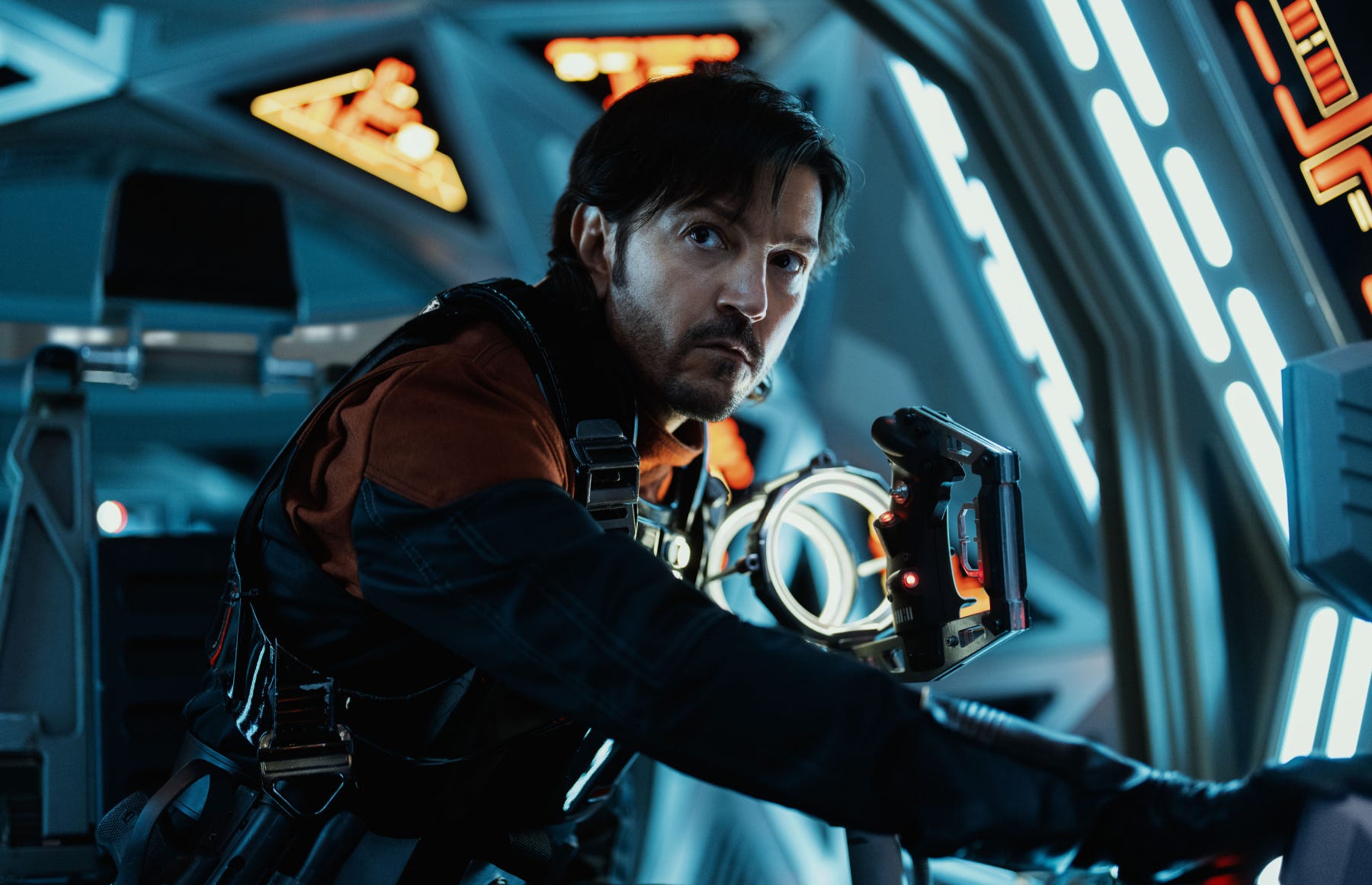
If you’ve been a Star Wars fan for a long time, you have a complicated relationship with everything that came after the original trilogy. Could anything match it? Why spoil a perfect thing by demanding more of it? And honest to goodness, what could they possibly have been thinking with Jar Jar Binks?
Which is why I make this recommendation gingerly, with all the usual caveats and asterisks attached. It’s Disney. It’s a series. It will never be Return of the Jedi. And Andor is exceptional.
It’s the best thing to come out of the post-trilogy profusion of content, and by a long shot. Diego Luna is terrific as Cassian, a thief and a cynic who has no interest in a rebellion until the Empire leaves him nowhere else to stand. Stellan Skarsgård plays the man who recruits him, and their scenes together are the best writing in modern Star Wars. The relationships are complicated and rich. The drama is riveting. It doesn’t have the sealed-off, virtual-set feeling of some recent Star Wars. Tony Gilroy, one of the main writers behind the original Bourne trilogy, leaned heavily on enormous practical sets and real locations, and you can feel the difference in every frame.
It’s understated and dark in a way that echoes the best of the original trilogy, without trying to recreate it. There are no Jedi here, no chosen ones, no prophecy. Just people deciding, one at a time, that they’ve had enough. [Jimmy]
📺 Andor (Disney+, 2022-2025)
3. The Dictionary of Obscure Sorrows : How Do You Invent Words?

I first came across the word ‘sonder’ when I was starting to dabble in spoken word. It refers to the realization that every passerby is living a life as vivid and complex as ours. It was a beautiful thought and I’d had it so many times but no word to express it. After that, I somehow found fellow bloggers adopting unheard-of names like ‘avenoir’ (the desire that memory could flow backward) and ‘kenopsia’ (the eeriness of a now-empty place that used to be bustling). The words had spread and how.
My favorites are chrysalism, the tranquillity of being indoors during storms, and ellipsism, the sadness of never knowing how history turns out. The idea of allocating words to feelings is fascinating. John Koenig, a college student at Macalester, started doing it when he was trying to write poetry and found the language lacking in the feelings he wanted to express. It was then that he came up with The Dictionary of Obscure Sorrows. It started as a blog, graduated to a YouTube channel and became a book in 2021. What can you say, poets are inventors!
Many of these words borrow from Latin, Germanic, and Greek origins so they sound like words that actually existed but were somehow forgotten. I found vemödalen pretty interesting. The frustration of photographing something amazing when thousands of identical photos already exist. Remember the countless sunset pictures we click on every vacation? I like how these new words evoke unknown sensations in us and sharpen the feelings we always had but couldn’t name. Sonder alone has been borrowed by a bike brand, a therapy company, a video game and a few albums. So, yes, words are literally for sale! But they do something far more important, they make versions of loneliness and awe feel collectively understood. [Aashisha]
📘 The Dictionary of Obscure Sorrows by John Koenig
4. Billy Joel: There’s More Than ‘Piano Man’
Until recently, I knew very little about Billy Joel or his music. I watched his interview with Rick Beato because I like how Beato gets musicians talking about their craft, and Joel was interesting enough that I then watched HBO’s two-part documentary, Billy Joel: And So It Goes.
Music was his escape from a life he didn’t want. He decided fairly young that music was going to be his life, and he threw everything into it, sticking with it through years of little reward.
Knowing little about his music except ‘Piano Man’ going in, I was surprised by the variety of styles and genres he explored. They’re very different artists, but that variety reminds me a little of David Bowie. You could never be sure what the next album would sound like.
His classical music roots come out everywhere once you know what to listen for. At one point, he plays “Uptown Girl” at the piano as if it were a Mozart piece and points out Tchaikovsky and Beethoven melodies in his work. But unlike most classical musicians, he learns classical pieces by ear.
His personal life is complicated enough to fill another documentary, and we learn how autobiographical many of his songs are. His ex-wives are there to tell their side, including Elizabeth Weber, who also managed his early career. I was interested in how often he seemed to get his life together and then run into trouble again, with self-destructive phases and relationship troubles. He had worked so hard to become a successful musician, but fame brought its own problems. Careful what you wish for…
The documentary sent me to The Stranger to start exploring his albums, and I’ve added a dozen of his songs to our family playlist. [Liberty]
📺 Billy Joel: And So It Goes (HBO, 2025)
5. The Last Picture Shows : The Theaters That Refuse to Go Dark
You’ve heard of food deserts. Rustin Thompson’s new documentary introduces a term that might haunt you longer: cinema deserts — vast stretches of the American West where the nearest movie theater is fifty miles away, if it exists at all. Thompson, a Seattle-based filmmaker and National Emmy winner, drove 10,825 miles across ten states and visited 123 theaters to find out what’s left of small-town cinema in America. He shot, wrote, edited, and directed the film almost entirely alone — just a camera, a tripod, a shotgun mic, and a slider. No crew. No lights. No lavalier mics. It’s filmmaking as lean as the towns he’s documenting, and the intimacy shows in every frame. It’s a technical approach that more filmmakers should embrace.
What he found was a complicated narrative. Some theaters are abandoned, their marquees dark and their lobbies exposed to the elements. Others are barely hanging on — one owner profiled in the film has lost more than $100,000 two years running. He keeps projecting anyway. But the most compelling stories belong to the theater operators who have reinvented their spaces as nonprofits, turning movie houses into community centers that host live music, graduation ceremonies, Met Opera broadcasts, and yes, still films. Thompson originally intended the film to be a black-and-white elegy in the spirit of Peter Bogdanovich’s 1971 The Last Picture Show, whose clips he weaves throughout. But meeting the owners changed the tone. They were, as the New York Times put it in naming the film a Critics Pick, “a feisty bunch” — willing to name the studios that bully them (A24 and Disney among the worst offenders, threatening to cut off film access for months if a small theater dares to break from their schedule) while still showing up every night to keep the projector running.
There is something about a glowing marquee on a dark Main Street, framed against a western sky, that makes you want to buy a ticket to whatever’s playing. Find a movie house playing it while you can. Bonus if you can drive there. [Taylor]
🎬 The Last Picture Shows (directed by Rustin Thompson, 2026)
⭐ Explore the OSV Field Notes Archive ⭐
Enjoyed OSV Field Notes? 💌 Forward it to a friend!

Good stuff, as always. My parents had me grow up on Billy Joel on long road trips. We didn’t move to very upstate NY until I was in high school, but NY state of mind remains one of our favorites and continues to grow on me as I often visit the big city now. The documentary is really great and shows how complicated and accomplished Joel was. He tells great stories.