
Welcome to OSV Field Notes, a weekly, high-signal curation of things worth your time.
This week: familiar things can become something else when taken seriously enough. A 133-year-old fireworks family turning Hunter S. Thompson’s dying wish into a spectacle, a web page that reminds you the browser can still be a laboratory, a Lakers drama that got close enough to the dynasty to provoke an answer, a food podcaster who treated pasta like a startup, and Louis C.K. turning FX money and a laptop into one of the rawest shows to get passed the corporate suits.
1. The Fireworks Family That Fired Hunter Thompson Into the Sky
Today is America’s 250th birthday, and there’s a decent chance the fireworks you see will be made by a family that’s been doing this for 133 of those years.
In 1893, a sixteen-year-old Italian immigrant named Antonio Zambelli arrived in New Castle, Pennsylvania, with a notebook full of his family’s pyrotechnic recipes and took a job in the Carnegie steel mills. He started making fireworks by hand on the side. Four generations later, Zambelli Fireworks is still family-run, still based in New Castle, and still the company behind many of the biggest shows in the country — more than 2,000 displays a year, 800 of them on the Fourth of July alone.
They’ve fired their rockets for every president since Kennedy. They lit up the Statue of Liberty centennial, Mount Rushmore, Times Square on New Year’s Eve, and the wedding of Prince Charles and Princess Diana.
But the show I keep coming back to happened on a Saturday night in August 2005, in Woody Creek, Colorado. Hunter S. Thompson — the gonzo journalist, author of Fear and Loathing in Las Vegas, and one of the most ungovernable writers in American history — had shot himself six months earlier at age 67.
He’d spent decades telling anyone who’d listen exactly how he wanted to go out: his ashes blasted into the sky from a 153-foot monument shaped like his personal logo, a two-thumbed red fist with a peyote button at its center.
His friend Johnny Depp wrote the check for $3 million. Zambelli got the call. Technicians at their Pennsylvania facility encased Thompson’s remains inside mortar shells, sealed them with fireworks, and drove the whole payload to Colorado in an armored car.
At sunset, in front of 350 guests — John Kerry, Bill Murray, Ed Bradley, George McGovern — 34 lines of fireworks erupted simultaneously. Thompson’s ashes lingered in great puffs of milky smoke, then vanished. The blast itself lasted less than a minute.
A 133-year-old family business, a notebook of recipes from Naples, and the wildest funeral in American literary history. That’s a hell of a Fourth of July story. [Taylor]
2. Bartosz Ciechanowski: The Web Page as a Thinking Machine

Once in a while, I find something that reminds me the web doesn’t have to be bland and boring.
Bartosz Ciechanowski makes loooong, beautiful, interactive explanations of complicated systems: mechanical watches, GPS, airfoils, bicycles, gears, sound, and the Moon. That sounds like a kind of blog, but his pieces are closer to museum exhibits in a browser. You drag the Moon around and scrub time. You rotate a watch movement and look at what is going on with the mechanism. You drop particles into air flowing around a wing in a virtual wind tunnel.
Ciechanowski builds mechanisms you can operate and play with, so you don't just understand cause and effect, you actually feel it.
I like that the subjects he picks are things we don’t even notice anymore. Planes fly. GPS works. Watches tick. Bikes move and stay upright when you pedal. Then I read one of his essays, and, oh yeah, familiarity is not understanding.
Start with his piece on the Mechanical Watch if you like machines, Airfoil if you want the “make the invisible visible” experience, or GPS if you want to feel grateful for your phone. Ciechanowski’s work makes the modern internet feel a little unimaginative. We have this amazing medium, and we use it mostly to scroll. [Liberty]
3. The Sports Drama So Good the Lakers Made a Documentary to Answer It

A few months ago, I wrote about Hulu’s Legacy, the 10-part docuseries on the Buss family and the Lakers. What I did not mention is that Legacy was, among other things, the family’s response to Winning Time: The Rise of the Lakers Dynasty, the HBO drama that ran for two seasons before HBO pulled the plug in 2023. The show got under the family’s skin; maybe because it worked.
I am no expert on prestige television, but what impressed me most about Winning Time was the casting. The people they cast were phenomenally good fits, and each person looks and plays the part with an almost eerie degree of accuracy. John C. Reilly disappears into Jerry Buss. Quincy Isaiah, in his first major role, plays Magic Johnson with such easy warmth that after ten minutes you have forgotten you are watching an actor. Solomon Hughes, an actual former basketball player, plays Kareem Abdul-Jabbar with the exact silence and stillness the man carried. And then, most improbably, Adrien Brody plays Pat Riley. On paper, you would not think it works. On screen, within one scene, you cannot imagine anyone else in the part.
Watching a sport come to life this way is a strange pleasure. I have not seen many attempts at the form, and part of the fun of Winning Time was watching the writers figure out what a basketball dynasty looks like from the inside: one meeting, one loss, one late-night phone call at a time. The record is there on every page of the script. The Jack McKinney bike accident. The Westhead firing. The Riley elevation. The personalities and rivalries and small unhinged decisions that make a dynasty. Whatever the critics said, it was an act of imagination applied seriously, if not always literally, to real events. Real events aren't obligated to make a good story. This one did, and it deserved more than two seasons to finish telling it. [Jimmy]
📺 Winning Time: The Rise of the Lakers Dynasty (2022-2023)
4. The Pasta Shape That Was Also a Startup
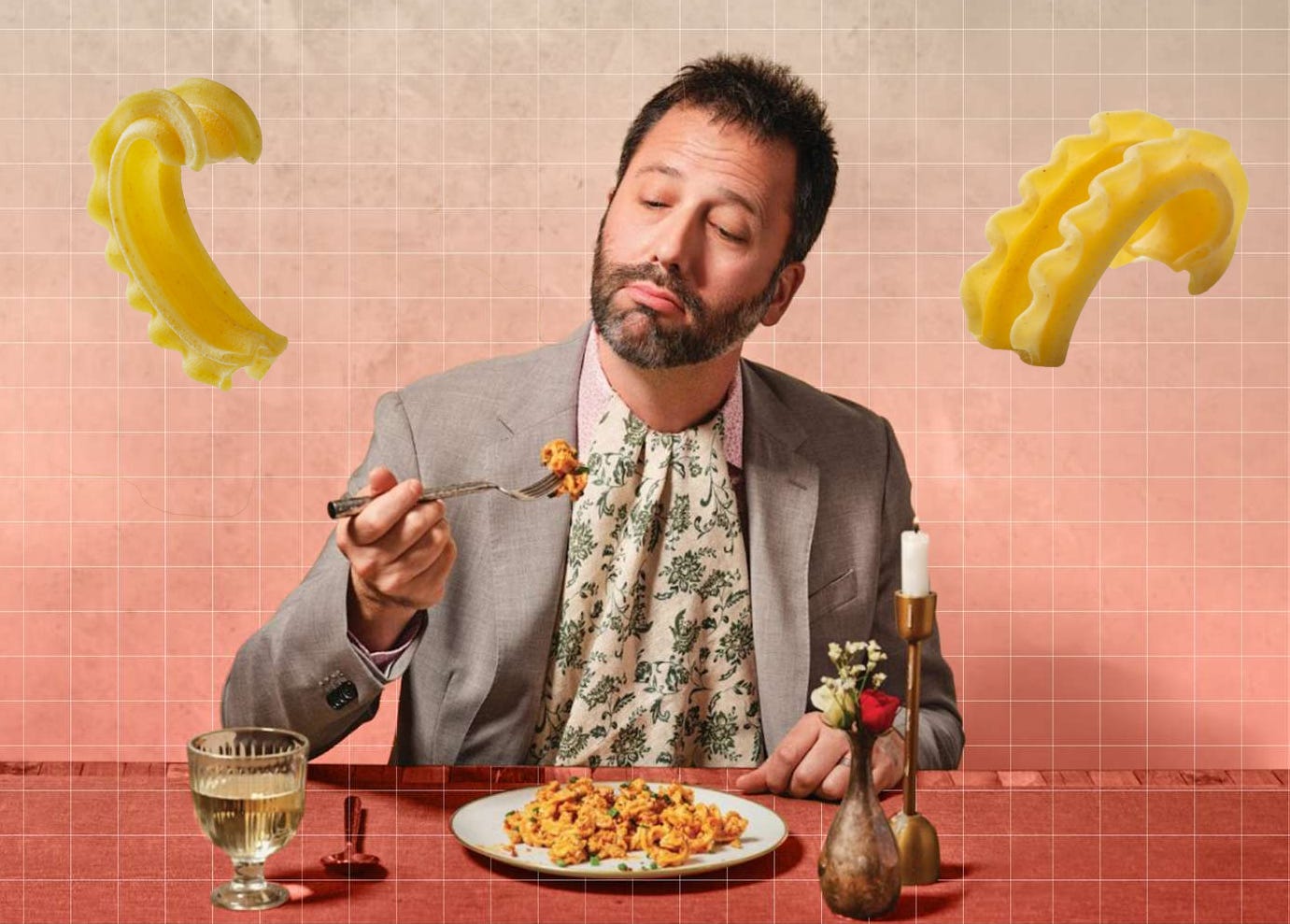
A few years ago, I listened to a five-part podcast series about a guy trying to invent a new pasta shape. I loved it, and I tried to buy the pasta, but it was sold out and I kind of forgot about it. Recently, my wife cooked some pasta with terrific home-made sauce, and I was reminded of this podcast and its quest for pasta nirvana.
I didn’t expect a podcast about pasta extrusion to scratch the same itch as a good startup story, but it did.
The man-on-a-mission is Dan Pashman, who’s run the food podcast The Sporkful for over a decade (three James Beard Awards, two Webbys). In 2018 he decided to try something he’d never done: not critique, but create. “I built a large part of my career on these opinions about food,” he says, “and yet, I’ve never really made anything. So maybe I don’t know what I’m talking about.” Inventing a pasta shape became, in his words, the ultimate test of his own opinions.
So he did what founders do: tried everything on the market, then made up his own way to measure what was missing. He came up with sauceability, forkability, and toothsinkability for the three jobs pasta has to do. Then he spent three years discovering that the real bottleneck was industrial: there’s one company left in the U.S. that still makes bronze pasta dies (solid discs the size of an extra-thick manhole cover, with dozens of holes for the pasta to extrude through, Play-Doh-style), and the factories built around them run tens of thousands of pounds a day, not the few thousand one guy with a podcast needs.
He named his pasta Cascatelli (after the Italian word for waterfalls, with the grammar wrong on purpose, because it sounded better with the “i” at the end). It launched in March 2021. The first 4,000-pound run sold out in under two hours. Pashman personally fronted about $9,000 for the new die, earned it back within the year, on the way to 300,000 pounds sold.
Why should you care if pasta isn’t your thing?
It’s a familiar arc: he’s sure he’s onto something, then he starts wondering whether he has gone bonkers, then manufacturer after manufacturer explains why his idea is annoying or impossible. Every small decision has unexpected consequences. The curve of the noodle, the thickness of the ridge, the length, and whether it cracks when drying. It reminds me of stories from founders and artists, even if it’s about comfort food.
TIME Magazine called it one of the year’s best inventions and a design museum in Germany asked Pashman for his original Cascatelli sketches (drawn on graph paper from a CVS) to put on display. Not bad for a podcast side project. [Liberty]
5. Louis C.K. Wrote, Directed, Starred In, and Edited This Show On His Laptop

I’ve never seen a work of art that so perfectly mirrors its artist as Louie. In 2009, FX gave Louis C.K. something impossible: near-complete creative control. It was unheard of then. It’s even more unheard of now. FX wired him the money and saw nothing until the finished episodes arrived. No studio-mandated writers’ rooms, no notes from the suits. He wrote it, directed it, starred in it, and edited it himself on his laptop. A pure, unfiltered vision. What came back was sixty-one episodes of some of the best television I’ve ever seen.
The show finds that deep, deep place where the underground rivers of tragedy, comedy, and drama intersect. The thing that hits you (and stays with you) is how raw it is. It doesn’t feel scripted, even if it is. The camera work is guerrilla. I still think about the opening shot, Louie coming up out of the subway, getting a slice of pizza, heading down the stairs into the Comedy Cellar. He doesn’t even romanticize New York. He makes it real.
And the best part: the stand-up in the show is actual-comedy-special good. This shouldn’t be remarkable, but it is. In every other show or movie that depicts comedy, the comedy sucks. Why is that? Why can’t they do it? Watch any film with a “brilliant comedian” character and you’ll sit through material you’d never pay for. Then watch “Louie” work the Cellar between vignettes and realise you’re seeing the real thing, embedded in fiction, and you can’t see the seams. [Dylan]
📺 Louie (2010-2015)
⭐ Explore the OSV Field Notes Archive ⭐
Enjoyed OSV Field Notes? 💌 Forward it to a friend!

Because of Dylan's piece I ended up listening to Louis CK's podcast with Rick Rubin last night and this morning. Interesting convo: https://open.spotify.com/episode/70pIECFrI2oFycMWEDuvr8
This reminds me I need to rewatch Louie! Haven't seen it since it came out, and didn't watch all seasons, but I remember liking it at the time.