
Welcome to OSV Field Notes, a weekly, high-signal curation of things worth your time.
This week: What we don't see when we see the finished thing. The Oscar-winning director who watches Jaws three times a year, a homeless nobody who became England's answer to Camus, a non-coder who built a hit game in a weekend, a bedridden writer who finished her masterpiece with her eyes closed, and a pre-fame Norah Jones record made with a reformed Vegas gambler.
1. At 63, Steven Soderbergh is Still an Apprentice
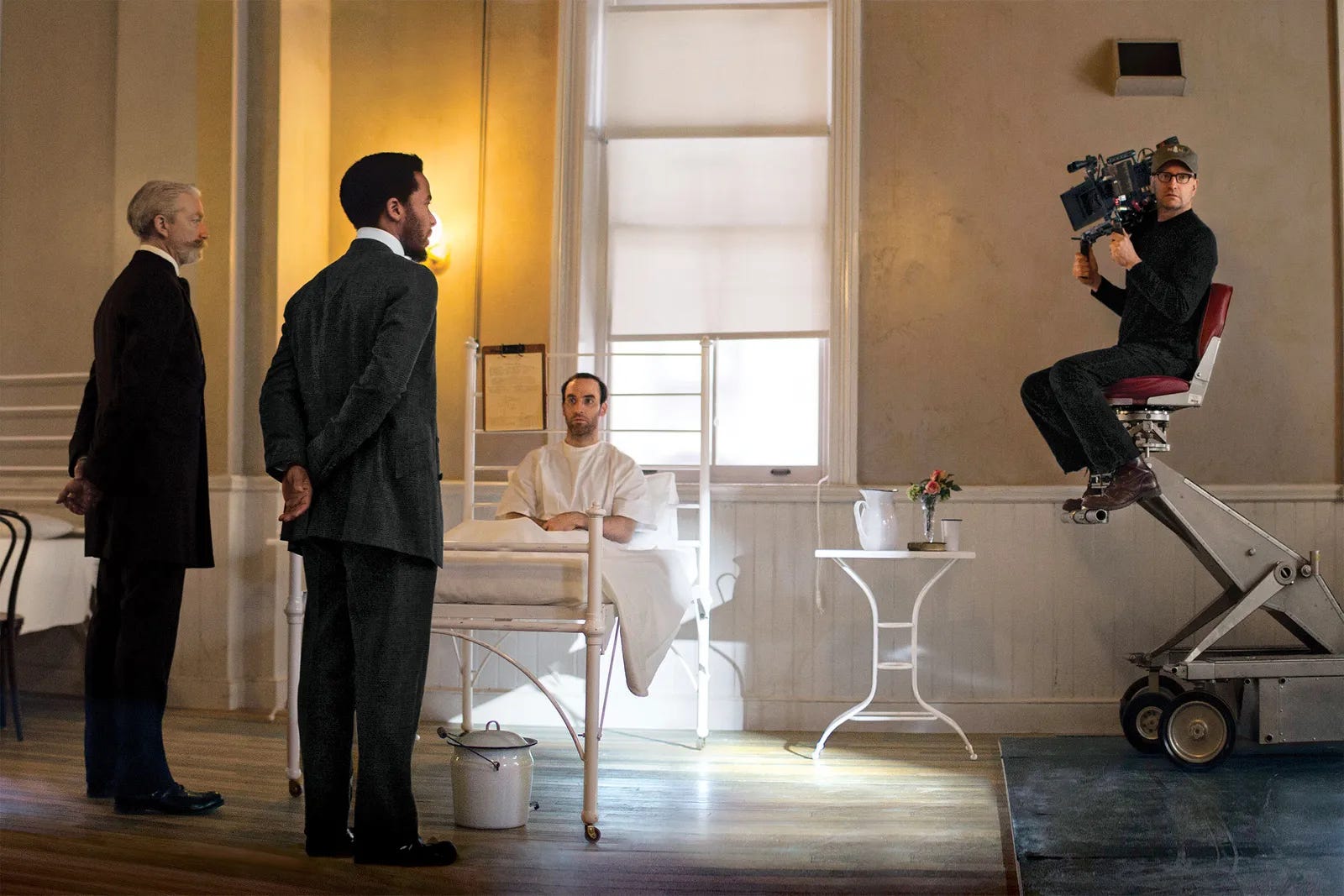
Steven Soderbergh had a better Christmas Day than you.
While you were ripping open presents like a toddler, he was easing into the 1953 prisoner-of-war thriller Stalag 17 (2 hours). While you were stuffing yourself with roast potatoes, he was locked into David Fincher’s jet-black thriller Zodiac (2.5 hours). And while you were lying comatose on the couch, he was just getting started with 2025’s head-bangingly intense road movie Sirat (2 hours).

Every January for several years now, Soderbergh has posted his media diary. Unlike the curated top ten lists you usually find at the end of the year, his lists are never filtered or editorialised. You are given two pieces of information: what he watched or read, and on what day.
There’s something strangely compelling in learning, in painstaking detail, exactly how a great artist spends his consumption time. It’s worth checking out the last few years’ entries. They’re packed with fun details (a surprise love for Below Deck), and insights into his astonishingly quick creative process (on 7 February, he began production on The Christophers; by 13 March, he’d already watched the first cut).
Above all, the diary reveals how, despite his success, Soderbergh still thinks of himself as a student.
You’d think that someone with a $2.2bn box office tally, fourteen Academy Award nominations (including best screenplay at just 27), a best director Academy Award win, and the title of youngest solo director to win the Palme d’Or, wouldn’t have much to learn from his peers. Wrong! Soderbergh has long worshipped Steven Spielberg and still studies the old master. Here’s all the Spielberg-adjacent output he consumed in 2025:
Watched Raiders of the Lost Ark twice.
Watched Duel twice.
Watched Jaws three times.
Watched The Sugarland Express.
Watched the Jaws @ 50: The Definitive Inside Story documentary.
Watched the Heavy Spoilers YouTube channel’s episode on Jaws.
Read BFI Modern Classics: JAWS.
Read BFI Modern Classics: Close Encounters of the Third Kind.
Read a biography of Robert Shaw.
Read Ready When You Are, Mr. Coppola, Mr. Spielberg, Mr. Crowe, by Jerry Ziesmer.
Soderbergh has also regularly praised his friend David Fincher. In 2025, he watched Zodiac, Panic Room, Seven and The Social Network. And it's not just contemporaries. He also bashed out The Godfather, Chinatown, Barry Lyndon and Citizen Kane.
Soderbergh still thinks he has a lot to learn from going insanely deep on films and directors he respects. If he does, then so do you. [Ed]
2. The Outsider : Why Some People Can't Accept Comfortable Assumptions

In 1954, Colin Wilson was a twenty-three-year-old nobody. By night, he slept rough in Hampstead Heath, a huge park in North London. By day, he stayed warm in the British Museum Reading Room, writing and reading like a man possessed. On Christmas Day of that year, Wilson opened his journal and wrote the words “Notes for a book The Outsider in Literature.” That sparked a flood of pages.
He typed up a few and sent them to the publisher Victor Gollancz. Gollancz was blown away. The Outsider was published eighteen months later. Cyril Connolly called it “one of the most remarkable first books I have read for a long time.” The day after that review ran, it was a bestseller. The first print run of 5,000 sold out on publication day. Wilson was hailed as England’s answer to Camus.
I came across this book on my father’s bookshelf. It touched on something I’d always felt but never articulated. Wilson’s thesis is that there exists a certain type of person who cannot accept the comfortable assumptions of the crowd. He calls them Outsiders, and traces the type through Van Gogh, Nietzsche, Dostoevsky, T.E. Lawrence, Hemingway, and more. People blessed and cursed by an excess of perception. They don’t want to be on the outside, like a hipster. They simply need to feel fully alive. And it is precisely by listening to and expressing this need that they produce masterpieces—works that instill a similar need in us; works that remind us of the Outsider inside all of us, and that we will never be fully alive, never fully ourselves, unless we listen to them. [Dylan]
3. GeoSports: Five Questions, One Globe, Zero Excuses Not to Play

A guy who describes himself as knowing “very little about software engineering” sat down a few weeks ago, opened Claude, and built a game from scratch. Seven days after launch, GeoSports has 366,000 total plays, 150,000 peak daily active users, and three major gaming companies in his inbox — all without paid marketing. If you’re looking for more proof of what AI tools are making possible right now, this is a good one.
The game itself is dead simple: five sports trivia questions a day, each tied to a location. You drop a pin on a globe. The closer your pin lands to the actual answer, the more points you score. Some are softballs — the city that’s home to Wrigley Field won’t stump anyone — but others send you guessing across continents. What Brazilian town was Pelé born in? Each session takes a few minutes. A leaderboard tracks your ranking for each day.
Frank Michael Smith built it in an eighteen-hour sprint after playing MapTap, a daily geography quiz, and wondering what a sports version would feel like. He shipped immediately. Day one: 79 players. Day two: 575. On day three, Kendall Baker — one of the most-read daily sports newsletter writers in the country — joined to help write questions and featured it, and by noon, GeoSports had crossed 4,000 players. A week later, 165,000 of those plays had been referred from X alone.
For anyone who remembers the white-hot rise and equally spectacular collapse of HQ Trivia, GeoSports scratches a similar itch — that daily, communal, low-stakes competition that makes you feel briefly smarter than your friends. The difference is the architecture: frictionless, fast, and built by one person with an AI copilot over a single weekend. That’s the part worth paying attention to. [Taylor]
4. Seabiscuit : An Endurance Story Folded Inside Another

In 1938, American newspapers devoted more column inches to a small, knobby-kneed racehorse named Seabiscuit than to Franklin Roosevelt, Adolf Hitler, or anyone else alive. Laura Hillenbrand’s Seabiscuit: An American Legend tells you why. The book gives full and equal weight to four lives: the horse, the half-blind jockey who lived in stalls and read Emerson, the cowboy trainer who barely spoke, and the bicycle repairman turned automobile magnate who built the whole thing into a national obsession. By the time the match race against War Admiral arrives, you are leaning into the turn.
What you don’t see on the page is the body that wrote it. Hillenbrand fell ill at nineteen, on a drive back to Kenyon, and went through a parade of doctors who told her it was puberty, or in her head, before Johns Hopkins finally identified it as chronic fatigue syndrome. She published an account of those years in The New Yorker in 2003 called “A Sudden Illness.”
It is one of the most honest pieces of personal history I have ever read. She lost the ability to walk a block, then down a hall. She spent two years with vertigo so violent that she could not read the back of a cereal box. She discovered Red Pollard, the jockey, in a photograph from the summer of 1938, on a cool fall day in 1996, when most days she could not stand up.
She wrote the book anyway. Her laptop sat on a stack of books because looking down made the room spin. When she was too dizzy to read, she wrote with her eyes closed. “Living in my subjects’ bodies,” she said later, “I forgot about my own.”
Seabiscuit would be a remarkable book under any circumstances. That she produced it while bedridden, in years when many doctors still refused to believe what she had, lifts it into something closer to a small miracle. Read “A Sudden Illness” first. Then read the book. Two stories about endurance, one folded inside the other. [Jimmy]
📙 Seabiscuit: An American Legend by Laura Hillenbrand
5. A Megastar’s Forgotten Gem, Made Pre-Fame With a Reformed Gambler

Norah Jones — the daughter of Ravi Shankar, the sitar virtuoso who taught George Harrison — sold 27+ million copies of Come Away with Me, her debut blockbuster (and it’s amazing, I highly recommend it). She sold 12+ million copies of Feels Like Home, the follow-up, and cumulatively over her career, she’s sold over 53 million albums, won 10 Grammys, and currently has over 8 million monthly listeners on Spotify.
Not exactly obscure, eh?
But somehow, there’s a gem that hasn’t gotten the attention it deserves. It’s one of my favorite albums of hers. We play it during family dinner. It always puts us in a good mood.
Why did it slip through the cracks?
She recorded it in August and September 2000, weeks before she made her own demos as a solo artist for Blue Note, and over a year before her debut album came out. It’s pretty jazzy, but it has stronger blues elements than her own albums. There’s no filler or fat: Six songs in 30 minutes, the whole band cooks, and it features some of the rawest vocal performances from one of my favorite singers. She sounds like she’s having fun, and the way her voice almost cracks in Deceptively Yours always gets me.
Who is Peter Malick, the man who gets top billing over Jones on this album?
He was a teenage blues prodigy from Brookline/Boston. His band ‘Listening’ was signed to Vanguard when he was around 16; then he played with people like Otis Spann, John Lee Hooker, Big Mama Thornton, and Muddy Waters.
Then he became guitarist/music director for Hair, joined the James Montgomery Band, recorded for Capricorn… and then more or less vanished from music for years. During that period, he made money as a gambler, including time in Vegas. He then started making records again and ended up meeting a pre-fame Norah Jones on the Lower East Side of Manhattan in 2000. They became friends, toured New England, recorded six tracks in Boston, and those tracks became New York City (but were only released after she became a superstar).
Thirty minutes of Norah Jones before the world had heard of her, recorded by a man who'd just spent two decades at the card table. [Liberty]
🎧 Listen to New York City on Spotify
🎧 Listen to New York City on Apple Music
🎧 Listen to New York City on YouTube Music
My wife makes fun of me for being a Norah Jones fan. She has the most sultry, soulful voice of any artist I know. Her music also puts me in a good mood.