
Welcome to OSV Field Notes, a weekly, high-signal curation of things worth your time.
This week: things that refuse to expire. A 1980s column that is still fresh in 2026, the 1881 bullet that took eighty days to kill a president, a trail cam that broke a hundred-year silence, a hundred manuscripts sealed until 2114, and a 1969 freeze-frame that hasn't aged.
1. Destiny of the Republic : He Survived the Bullet. The Doctors Finished Him.

James Garfield survived the bullet. What killed him, eighty days later, was his doctors. I read Candice Millard’s Destiny of the Republic years ago and have been pressing it on people ever since.
The setup is straightforward. A delusional office-seeker named Charles Guiteau shoots the new president at a Washington train station on July 2, 1881. Garfield lingers through the summer while Alexander Graham Bell, of all people, races to invent a metal detector that might locate the bullet. Meanwhile, his lead physician (a man whose given first name, improbably, was Doctor) ignores Joseph Lister’s antiseptic methods and probes the wound again and again with unwashed fingers. The infection finishes what Guiteau started. At trial, Guiteau’s defense was that the doctors did the killing. He was, in a strict medical sense, correct.
Millard braids three threads without ever letting the seams show. There is the history of Garfield himself, raised in an Ohio log cabin, who learned Greek and Latin on his way to becoming a college president, a Civil War general, and a reluctant nominee who arrived at the White House almost against his will. There is the science of germ theory at a time when it was reshaping medicine, and the cost of America’s reluctance to accept it. And there is Millard’s narrative engine that carries the whole thing forward.
The book closes with a quiet irony: the assassination shamed the country into dismantling the very spoils system that produced Guiteau in the first place. It is the best argument I know for the proposition that history, science, and storytelling belong on the same page. [Jimmy]
📙 Destiny of the Republic: A Tale of Madness, Medicine and the Murder of a President by Candice Millard
2. The Best Thing on Facebook Is a Trail Cam in Minnesota
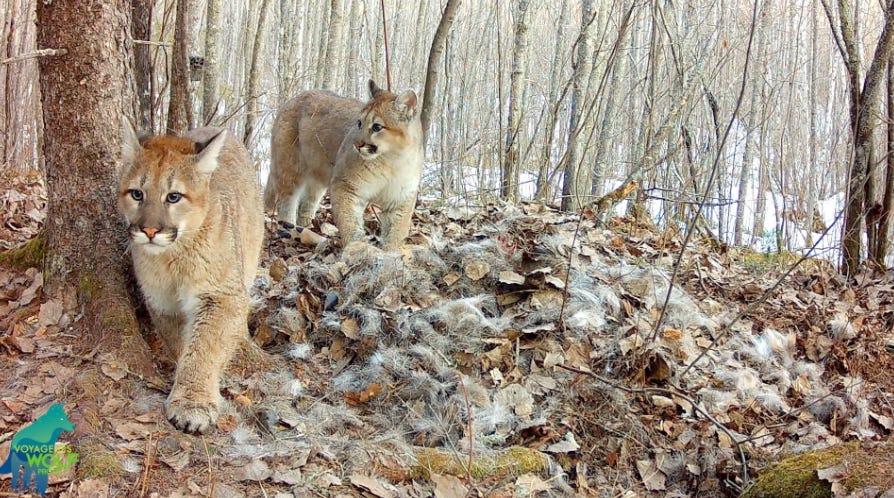
Last week, a University of Minnesota research team posted trail camera footage of a mother cougar and three kittens feeding on a deer carcass in northern Minnesota. It was the first documented evidence of cougars reproducing in the state in over a hundred years. The footage is surreal — you can hear the kittens growling and hissing at each other, the mother grooming them between bites. It wasn’t shot by the Department of Natural Resources (DNR) or a news crew. It was captured by the Voyageurs Wolf Project, a small research team that studies wolves in and around Voyageurs National Park, and it landed, as most of their best work does, on their Facebook page.
Voyageurs itself is one of the most under-the-radar parks in the National Park system — 218,000 acres straddling the Canadian border in northern Minnesota, 84,000 of which is water. With more than 500 islands, access is mostly by boat. It draws around 200,000 visitors a year, a fraction of what the big parks attract. The Wolf Project has deployed hundreds of trail cameras across this landscape to study what wolves do during the summer, which remains a surprisingly open question in wolf ecology. The footage they share on Facebook is a unique window into one of the wildest corners of the country. Wolves hunting beavers. Packs moving through fog at dawn. And now, cougars raising kittens for the first time in a century.
Following this page has become one of the few things that stops my scroll on Facebook. In a feed dominated by noise and slop, the Voyageurs Wolf Project is something else entirely: real science, captured in real time, from a place most people will never visit, funded largely by over 10,600 individual donors who care enough to buy the batteries and SD cards that make the cameras run. If your relationship with Facebook needs a reason to exist, this might be it. [Taylor]
🌐 Voyageurs Wolf Project website
🎥 Voyageurs Wolf Project on Facebook
📺 Voyageurs Wolf Project on YouTube
3. The Future Library: 100 Books, 100 Years, and 1,000 Trees

“You’ll have to die to get these books,” Ocean Vuong said about Katie Paterson’s Future Library — Framtidsbiblioteket — a hundred-year art project that began in 2014.
A thousand trees were planted in the Nordmarka forest just outside Oslo that year. If everything goes to plan, the wood of those trees will provide paper for the hundred books that won’t be printed until 2114. Every year, one author contributes a sealed, unpublished manuscript to the Silent Room of the Deichman Library. This room is a space built from a hundred layers of carved wood from the original trees that were cleared for the new plantation. Each layer holds a glass drawer for that year’s manuscript. You can visit the room and see the drawers, but reading is prohibited. Someone took writing for posterity a bit too literally.
Margaret Atwood was the first contributor who walked into the forest, did a ceremonial handover of her manuscript, Scribbler Moon, and walked away. David Mitchell (From Me Flows What You Call Time), Han Kang (Dear Son, My Beloved), Karl Ove Knausgård (Blind Book), and Ocean Vuong (King Philip) have since made the same walk into that forest.
David Mitchell let slip that he quotes the lyrics to ‘Here Comes the Sun’ in his book. The song won’t enter the public domain until the late 21st century, so he wrote a book that can’t legally be published in his own time!
I love how the 100-book project has zero measurable incentive for a writer in their lifetime: no sales figures, no reviews, no audience. They wrote out of the purest possible motive — because they wanted to, and because the work mattered.
I find it fascinating that a book written now might still mean something to readers in 2114, and that we trust those readers to still care. In an age of first-week sales and virality, I would call that an act of powerful optimism and deep time.
Well, the trees are already twelve years old. Only eighty-eight years to go! [Aashisha]
🌐 Future Library Project (Wikipedia)
4. The Last Cool Guy in New York: Glenn O’Brien’s Like Art

My recent obsession is discovering the inner workings of ‘culture creators’—obsessives with taste, who cultivate cool and turn it into influence.
Glenn O’Brien fits that description neatly.
O’Brien wore a lot of hats: writer, creative director, ad man, comic, public intellectual, socialite. He was at The Factory as a Columbia film student, became the first editor of Warhol’s Interview in 1970 (alongside Bob Colacello), and went on to write for Rolling Stone, Artforum, High Times, Spin, and Playboy. His final gig, before his death in 2017, was GQ’s Style Guy.
My introduction to O’Brien came when somebody recommended Like Art: Glenn O’Brien on Advertising to me. The book is a collection of his columns on Advertising, written for Artforum between 1984 and 1990.
I like O’Brien’s work because it’s a perfect anti-algorithm choice. His voice is bold, witty, and charming. For example, his remarks on the fusion of art and commerce:
Advertising was like art, and more and more art was like advertising. Ideally, the only difference would be the logo. Advertising could take up the former causes of art—philosophy, beauty, mystery, empire.
He puts on the charming air of a ‘gentleman of leisure’, but there’s a strong discipline behind his work. There is an art to deploying a perfectly timed aphorism, and O’Brien had it:
It’s always better to be overdressed than underdressed for an occasion. It will appear that you are going somewhere better later.
You can’t improve the discourse without improving the language, and you can’t improve the language by sticking to the hoity-toity of it. You’ve got to get down and dirty with it.
People remember a good listener better than a good talker.
At a time when everybody’s voice is converging into AI-inflected slop, Glenn O’Brien’s columns are a perfect cleanse.
O’Brien’s parting line lands as well as any: “Always be on the lookout for people who remind you of you… Smart, secure, cultured, cool… We are allies in the cultural conquest of the world.”
Smart, secure, cultured, cool. What a wonderful profile to aspire to. [Rohan]
5. Butch Cassidy and the Sundance Kid : The Buddy Movie's Original Chemistry

I watched Butch Cassidy and the Sundance Kid (1969) with my kids this week. It was their first time. It’s one of my favorite films, but I was a little worried how they would handle the 1969 pacing. The full credits roll before a single scene, and there’s an extended travel montage that is just sepia photos.
But they LOVED it!
My oldest and I have been quoting lines back and forth all week. William Goldman, who famously said 'Nobody knows anything' about Hollywood, sure knew how to write memorable dialogue (see also: The Princess Bride, All the President’s Men).
What stuck with me on this rewatch: the bad guys are barely characters. The famous “Who are those guys?” posse is shot as a distant, mythic thing. Director George Roy Hill deliberately refused to give them faces. The real antagonist of the film isn’t a sheriff or a gunslinger. It’s the 20th century: railroads, payroll systems, Pinkertons with telegraph lines, institutions that never get tired and can keep coming after you. Charm doesn’t scale against institutions.
There’s a true story about the real Butch that Goldman loved. He called it “the best character introduction I ever came across,” but didn’t end up using it. Butch was offered parole by the governor of Wyoming on the condition he go straight. Butch basically told him: “I don’t want to lie to you, I can’t promise that. But I promise I won’t rob banks in Wyoming.” He got a deal. I mean, how charming do you have to be to get that offer? That episode is the whole story in miniature.
That film runs on Newman and Redford's chemistry. It set the modern buddy movie template. Buddy duos existed before (Hope and Crosby, Abbott and Costello), but those were mostly vaudeville routines. Butch Cassidy established the version that endures: two leads whose rapport is the engine, the plot exists to give them things to do. 2+2=5. Countless others have copied the structure. Almost none have matched the chemistry.
Redford himself liked the role enough that he named his Utah land after the character. That land became the Sundance Institute, which became the Sundance Film Festival (you may have heard of it).
The freeze-frame ending perfects the trick. The film doesn’t deny their deaths. It freezes them as legend at the exact moment history was about to make them corpses. [Liberty]