
Welcome to OSV Field Notes, a weekly, high-signal curation of things worth your time.
This week: a career begins the night a marriage ends, a film that adapts the author instead of the book, the composer who is everywhere and invisible, a YouTube weather network that beats the pros, and 60,000 oil paintings that refused to stay on the wall.
1. The Marvelous Mrs. Maisel : Twenty-Two Emmys, and You Still Haven’t Watched It

I’ll step outside my usual territory of books and documentaries to recommend The Marvelous Mrs. Maisel, which may be the most criminally underwatched show of the last decade. It ran for five seasons, was nominated for 80 Emmys and won 22, and yet I frequently meet people who haven’t seen it. Rachel Brosnahan is brilliant in the lead role, but what makes the show essential is the writing. It’s sharp, fast, layered in a way that rewards attention. The dialogue has rhythm, which is not surprising since the show was created by Amy Sherman-Palladino, who also created the hyper-verbal Gilmore Girls. The characters talk over each other in ways that feel lived-in rather than choreographed, and the humor lands because it’s grounded in real stakes.
The show is about Midge Maisel, a 1950s housewife in New York who discovers she has a gift for stand-up comedy after her marriage falls apart. On the surface, it’s a period comedy about a woman breaking into a male-dominated field. But really, it’s about what it takes to succeed in a creative profession: the doubt, the grinding work, the nights when you’re not sure if what you’re doing matters to anyone but you. It’s about the audacious act of remaking yourself, of building a career in something you’ve never done before, and anyone who has tried to do that will recognize something in it.
What I keep coming back to is how well the show understands the interplay between characters. Midge’s relationship with her manager Susie, her parents, her ex-husband, the other comedians she crosses paths with - all of it feels textured and real. The writing gives each character a distinct voice and lets them collide in ways that create friction and warmth in equal measure.
It’s a show about ambition, yes, but also about the people who make that ambition possible, the ones who believe in you before you’ve earned it. [Jimmy]
📺 The Marvelous Mrs. Maisel (2017 - 2023)
2. Reality is Optional: Cronenberg’s Naked Lunch
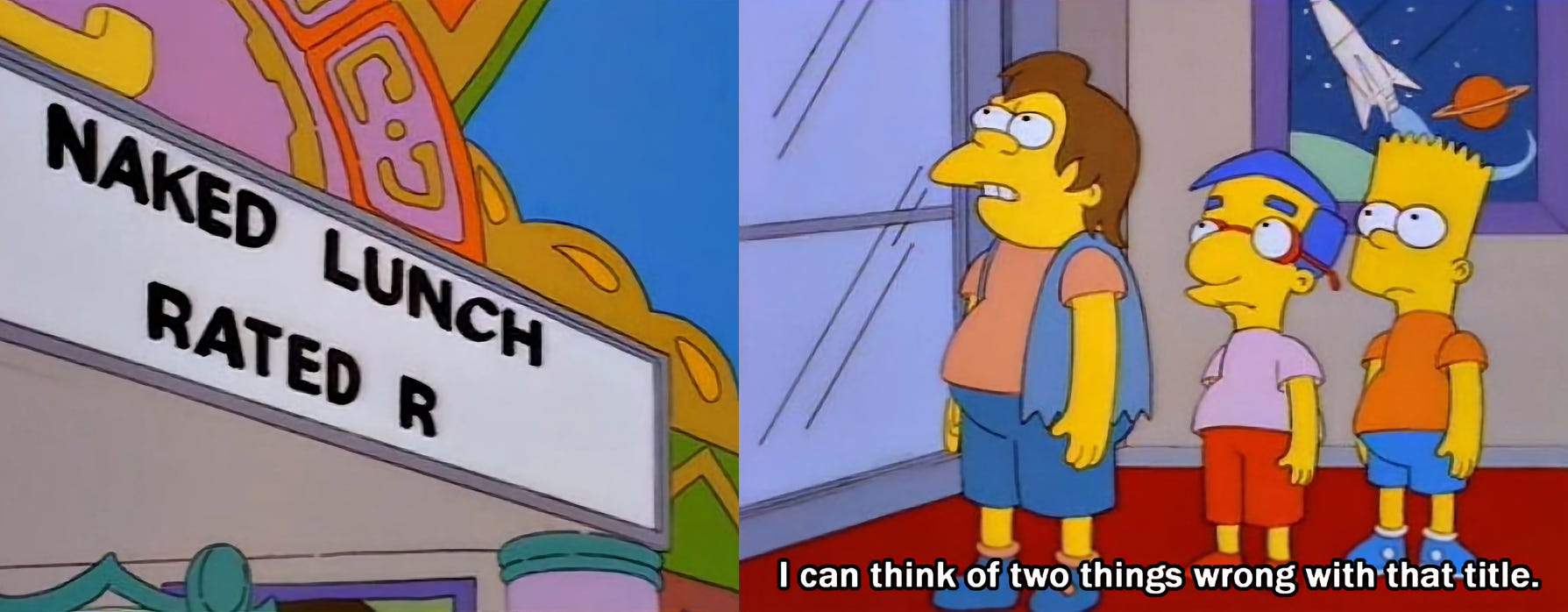
I’ve always struggled with David Cronenberg. There is something about his brand of minor-key weirdness that I find difficult to connect with emotionally, and his jet-black sense of humour - by all accounts the skeleton key to truly loving his work - tends to bounce straight off me. I expect I’m the problem here, but alas.
That’s not to say I don’t appreciate any of his movies. The Fly and Dead Ringers are undeniable, as is A History of Violence, his slyly provocative riff on the revenge thriller. But his more ‘out there’ movies like Videodrome, Crash and Crimes of the Future left me frustratingly cold.
At first, so did Naked Lunch, his 1991 interpretation of the supposedly unfilmable William S. Burroughs novel. But, as the days have passed (I watched it last week), it has stubbornly continued to crawl around the dusty corners of my consciousness like one of the cockroaches encountered in the film’s opening scene.
Peter Weller (Robocop himself) plays the bug-eyed, sharp-cheeked Bill Lee, a spiritually comatose exterminator who becomes addicted to the hallucinogenic powder he uses as poison. From there, things take a turn for the surreal as he encounters talking typewriter-turned cockroaches, shapeshifting centipedes and sugar-slurping aliens called mugwumps. All of this is brought to life through astonishing craft - the gooey, gloopy special effects are as good as you’ll ever see.
I read something the other day arguing that true avant-garde film doesn’t differentiate between the surreal and the real. While Hollywood tends to adopt an Alice-in-Wonderland logic of Real vs Imaginary, the underground film dissolves the boundary between them. That’s how I feel about this movie. Much has been written about it as a metaphor for writing, or for addiction, or for homosexuality. All are true; none are true: Naked Lunch operates on a level of abstraction that renders one-to-one analysis as hopeless as trying to grab mist.
Naked Lunch isn’t really an adaptation of the novel in the conventional sense - it’s partly a portrayl of Burroughs writing the novel, including the famous incident where he shot his wife, Joan Vollmer. And in doing so, Cronenberg blurs the real (Burroughs’s life) and the fictional (the novel’s events) until they’re indistinguishable.
On a less philosophical note, any film whose climax features a leering Roy Scheider with a daft accent emerging caterpillar-like from the bosom of a domineering housekeeper is surely worth two hours of your time. [Ed]
🎬 Naked Lunch (1991)
3. Music by John Williams : The Musical Time Machine
Watching this was a strange kind of time travel because so much of Williams’ music is burned in my synapses. It’s fused to the movie scenes that put it there. The Jaws shark. Luke’s binary sunset. Indy on horseback.
The more interesting thread, though, is the portrait of the man, and inevitably, of Spielberg, since Williams has scored all but five of his feature films across a 50+ year collaboration.
They’ve worked together so long, and so closely, that you can’t really make a documentary about one without making it partly about the other. Some creative partnerships become impossible to discuss separately, where 2+2=5: Spielberg/Williams, Scorsese/De Niro, Kurosawa/Mifune, Lennon/McCartney.
Watch any of Spielberg’s famous scenes with the score muted, and they’re still very good, but you realize how much of the emotional work the music is doing.
I hadn’t realized Williams was already 45 when he wrote the score for Star Wars. At an age when most careers are easing into their third act, his was just starting to truly reach escape velocity.
In another century, Williams might have been a Tchaikovsky or a Wagner, a composer with a symphonic catalogue studied on its own terms. Instead, film gave him the largest audience any composer in history has ever had, and also made it harder to hear his work as its own thing.
The best moment in the doc: Williams tells Spielberg, after a rough cut of Schindler’s List, “I really think you need a better composer than I am for this film.” Spielberg replies, “I know, but they’re all dead.” [Liberty]
🎬🍿🎧 Music by John Williams (2024, Disney+)
4. The Army of Storm-Chasers That Beat the Sirens

Last week, three days of severe weather tore through Southern Wisconsin — hail, flooding, tornadoes. My mom still lives there. I was sitting in Denver, watching a tornado touch down just west of her house on a YouTube livestream from a meteorologist named Max Velocity, and I called her before the local TV station had even issued the warning. I saw Twister in the theater as a kid. I could never have imagined that storm tracking and storm news would converge in a format I could hold in my hand from anywhere in the world.
Max Velocity is a meteorologist from Embry-Riddle who started posting forecast videos on YouTube in sixth grade and now has over 1.8 million subscribers. Whenever severe weather threatens anywhere in the United States, he goes live — sometimes for up to six or eight hours — and what he’s built around those streams is genuinely impressive, sometimes identifying tornado threats at the street level before local weather services issue warnings. He taps into a patchwork of Department of Transportation cameras to give viewers real-time ground-level visuals. He coordinates a network of storm chasers whose positions overlay his weather maps — click on any of them and their live video feeds pop up. I was riveted watching live storm chasers race down country roads I biked on as a kid, as the storm moved closer to my mom.
There’s a bigger shift underneath all of this. Younger audiences aren’t waiting for the local TV meteorologist to break into regular programming anymore. They’re pulling up YouTube on their phones, and creators like Max are filling that gap with coverage that’s faster, more granular, and more useful than what most local stations can deliver. Viewers tip him via Venmo and PayPal as a thank-you for warning them about storms heading their way. That’s not a media model the Weather Channel was planning for. But it’s the one that helped me warn my mom before the sirens did. [Taylor]
5. Heroic Times : When Hungarian Oil Paintings Go to War

I refuse to call this an animated film.
Because the moment I call Heroic Times an animated film, some of you will lose interest, assuming it’s childish. When the reality of this 1984 Hungarian masterpiece is more like walking through a museum and watching the paintings come alive.
Loosely based on János Arany’s Toldi trilogy, about the legendary Hungarian hero Miklós Toldi, Heroic Times is a beautiful fever dream made from 60,000 oil-painted cel-sheets and 600 backgrounds (yes, painted, not drawn). The team that made it wanted to pay homage to the Hungarian Romantic painters of the 19th century, and the result is an art style you have never seen before in traditional Western animation.
On top of the one-of-a-kind visual experience, the story is also captivating. There are many elements of your classic knight in shining armor tale of bravery and daring, but there is more moral complexity to it than anything I’ve ever read in King Arthur tales. It has philosophical dilemmas that left me pondering the story after the credits rolled.
The thoughtful pace and subtitles of this film demand that you watch without a phone in hand. It requires your full attention, or you will miss out on the best parts of this curious masterpiece, which swaps out the frenetic energy of most movies today for the chance to witness art come to life in the retelling of one of Hungary’s oldest legends.
I guarantee it’s worth putting your phone away for about 90 minutes. [Jameson]
🎬 Heroic Times (1984, original title: Daliás idők)