
Welcome to OSV Field Notes, a weekly, high-signal curation of things worth your time.
1. Jiro Dreams of Sushi : Still Not Perfect at 100

Jiro Dreams of Sushi is a 2011 documentary about Jiro Ono, a sushi chef who runs a ten-seat restaurant near a Tokyo subway station. When the film was made, Ono was 85 years old and the restaurant had three Michelin stars. Last October, he turned 100. Asked by the Tokyo governor what the secret to his longevity was, Ono replied simply: “I believe the best medicine is to work.” He still hasn’t fully retired.
What strikes me every time I watch the film is the specificity of Jiro’s obsession. He has spent more than eight decades making sushi, and he still believes he hasn’t perfected it. His apprentices train for years before they’re allowed to cook rice. One of them practiced making tamago (egg sushi) for months before Jiro finally told him it was acceptable. The film lingers on these details because they are the point. Mastery is a practice, renewed every day, and the people who achieve it are the ones who find meaning in the repetition itself.
The documentary also captures something melancholy about excellence at this level. Jiro’s sons work alongside him, but they will always be in his shadow. His eldest, Yoshikazu, is now in his sixties and widely considered a master in his own right, yet he still runs the restaurant under his father’s name and his father’s standards. There’s a tension between inheritance and identity that the film handles with restraint, letting you feel the weight of expectation without ever stating it outright. Yoshikazu has spent sixty years mastering an art form he'll never fully own. It’s a family story as much as it is a story about craft.
I find the film genuinely inspiring. Watching Jiro work makes me want to be better at my own craft, to care more about the details, to find joy in the pursuit rather than the arrival. The best work about excellence makes mastery look worth the effort. [Jimmy]
🎬 Jiro Dreams of Sushi (2011)
2. Dostoevsky: Begin the Climb

Dostoevsky is a daunting prospect. His novels are intimidating mountains to climb, even for seasoned readers. More daunting still is the fact that the man has so many classics to choose from—classics that run 700, 800, 900 pages, I should add—that most people never begin. They’re terrified of finding themselves halfway up the wrong peak.
“Where do I start? Crime and Punishment or The Brothers Karamazov?” That’s a question I’m often asked.
My answer is always the same: Notes from Underground.
It’s the perfect introduction to his psychology, philosophy, and style (and it’s only about 120 pages).
Written as a monologue by a bitter, anonymous man ranting about everything wrong with himself and the world, it’s actually one of existentialism’s foundational texts—the school of thought that would give rise to Kafka, Camus, Sartre, and countless others. There’s a passage in it that’s among the most profound in all of literature, ending with the line: “The whole work of man really seems to consist in nothing but proving to himself every minute that he is a man and not a piano key.” Human beings are not widgets to be placed in some mechanical system, nor will they ever accept such a fate. It perfectly encapsulates the fundamental difference between man and machine, and echoes as loudly in 2026 as it did in 1864.
So there you go. No more excuses about Dostoevsky. 120 pages. Begin your ascent. [Dylan]
📙 Notes from Underground by Fyodor Dostoevsky
3. Treme : The Other David Simon Masterpiece

Sometimes among siblings, one gets all the attention — and they deserve it. They’re brilliant, kind, beautiful, funny. The real deal. But there’s another sibling who’s also exceptional, quietly overshadowed. Treme is The Wire‘s quieter sibling.
The Wire is one of the greatest shows ever made. I’ve said so before, and I mean it. But David Simon and Eric Overmyer’s overlooked follow-up, set in post-Katrina New Orleans, asks a question The Wire never quite gets to: when the institutions fail completely — when the levees break, the government disappears, your neighborhood is underwater — what holds a community together?
Culture. Music, food, ritual, craft.
The Mardi Gras Indians sewing their incredible suits from exile. A chef fighting to reopen her restaurant. A trombonist scraping by on gigs. Over four seasons, these characters and a dozen more rebuild their lives in a city that is simultaneously one of America’s most beautiful and most broken, with French, Creole, African-American, and Caribbean traditions layered over one another.
The production is obsessive about authenticity. Real New Orleans musicians — Kermit Ruffins, Dr. John, Trombone Shorty, Allen Toussaint — play themselves. Scenes are shot on location. One of the leads, Lucia Micarelli, is a Juilliard-trained violinist who had never acted before. And John Goodman in one of his best roles (along with Big Lebowski, of course). The show has 97% on Rotten Tomatoes, higher than The Wire's 94%. Simon himself called it "a better executed, more careful project." Yet it barely averaged 0.57 million viewers by its second season. Nobody saw it, and that’s tragic.
This isn’t a show for everyone. There are extended musical performances woven into the storytelling, and it’s largely about character moments. But if it is for you, it’s really for you, and nothing else will quite do the same job. If you decide to try it, commit to at least three episodes.
Years after my last rewatch, I still feel like I know these people. They’ve become friends. What more can you ask? [Liberty]
📺 Treme (2010–2013, 4 seasons, 36 episodes)
4. Middle-Earth Was Built in the Margins

Unfinished Tales is the book you pick up when you know Middle-earth well enough to want a glimpse into how Tolkien built this world.
If you’ve already read The Hobbit, The Lord of the Rings, or perhaps you’re a big enough Tolkien fan to have read even The Silmarillion, this could be for you. Edited and published posthumously by Christopher Tolkien, Unfinished Tales of Númenor and Middle-earth is a glimpse into Tolkien’s workshop — the drafts, the contradictions, the obsessive detail — which is precisely why I found it so absorbing.
It made me realize how the scale of Middle-earth was fueled by the enormous labor behind it.
Here you find alternate accounts of Galadriel’s past since Tolkien hadn’t settled on a final version yet, Gandalf explaining how Bilbo became part of Thorin’s quest, and fragments, annotations, and unresolved ideas that reveal how exacting he was. Even small details carry weight: why Saruman secretly acquired a taste for pipe-weed, or the precise value of the Númenórean mile.
It is not as exhaustive as Christopher Tolkien’s later 12-volume archival series, The History of Middle-earth, but it is a far more readable entry point into the same workshop. The success of Unfinished Tales later paved the way for The History of Middle-earth.
The book is divided into sections on the First, Second, and Third Ages, followed by a final section of notes and essays. It’s not an easy read. Some sections feel like notes rather than stories. But for Tolkien fans — and especially aspiring fantasy writers — that's exactly the point. This is where you see how he built it.
What makes it worth the effort: seeing that even the father of high fantasy struggled with unfinished scenes and contradictory drafts — the same man who ended up codifying and lending legitimacy to a genre formerly considered niche and juvenile. [Aashisha]
📘 Unfinished Tales: A Comprehensive Epic Fantasy Companion to the History of Middle-earth by J. R. R. Tolkien & Christopher Tolkien
5. A Field Guide to the Restaurants You Forgot You Missed
I was a child of the 1980s. My family didn’t eat out much, but Pizza Hut was the exception. The memories are almost unreasonably vivid: the red roof, the glazed plastic cups of Pepsi, the checkerboard tablecloth, the Galaga machine glowing in the corner.
I was a Book It! kid. It was Pizza Hut’s brilliantly cynical reading program that bribed children with free Personal Pan Pizzas for hitting their book quotas, which, in hindsight, might be the most effective literacy campaign a corporation has ever run. Now, as a parent with kids of my own, I find myself revisiting those memories more than I expected. Not out of sentimentality, exactly, but because there’s something about the sensory specificity of those places — the lighting, the architecture, the signage — that feels like a counterweight to the copy-and-paste sea of sameness that exists across almost every town in America.
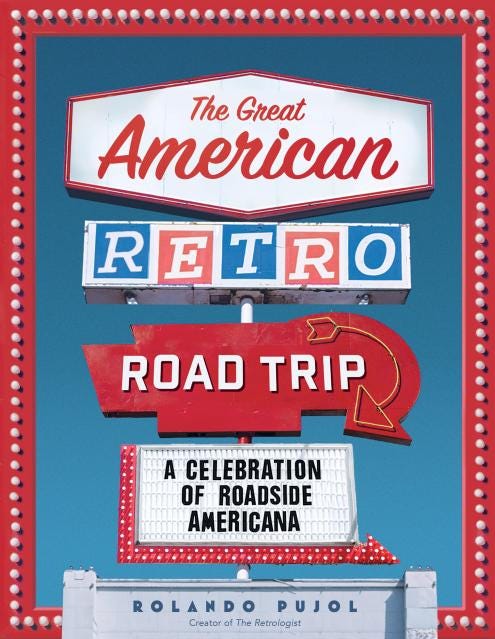
Rolando Pujol’s The Great American Retro Road Trip is the perfect gazetteer to many of the remnants that survived from my childhood. Pujol, who writes the fantastic Substack newsletter The Retrologist, has spent years documenting the surviving relics of roadside America — from Pizza Hut to the original Pronto Pup, as well as the giant roadside oddities and neon motel signs that most people drive past without a second look. The book is a coast-to-coast catalog of these places, but what makes it more than a photo collection is Pujol’s storytelling. He traces the origins and design histories of chains both national and deeply regional — this book introduced me to dozens of places I never knew existed as a kid. Each entry reads like a small act of preservation, a case for why this stuff matters before it disappears entirely.
I’ve started bringing it along on road trips. It turns out nostalgia is a better travel guide than most algorithms, and Pujol has drawn the map. [Taylor]
📚The Great American Retro Road Trip by Rolando Pujol
Funny you use the analogy of a mountain for Dostoevsky. I also use that metaphor through my Brothers Karamazov book club as I outline the chiastic structure in the book; the plot has two half which mirror each other on the way up and the way down. Here’s a post that outlines that mountain: https://armchairnotes.substack.com/p/dostoevskys-mountain-of-meaning
Here’s the list of book club videos and essays for anyone who wants to go deep on the Karamazovs: https://armchairnotes.substack.com/p/the-brother-karamazov-book-club-2026