
Welcome to OSV Field Notes, a weekly, high‑signal curation of things worth your time.
1. The Defiant Ones : When Taste Becomes an Empire

HBO’s The Defiant Ones is a four-part documentary that has been a longtime favorite of mine because it does something rare: it treats the business story and the personal story as inseparable. It’s about two people who probably shouldn’t have become partners: Jimmy Iovine, a working-class kid from Brooklyn who talked his way into recording studios, and Dr. Dre, a quiet perfectionist from Compton who heard sounds nobody else could hear. The series traces their parallel journeys through decades of American music, from Iovine engineering records for John Lennon and Bruce Springsteen to Dre inventing the sonic template for West Coast hip-hop, until their paths finally converge in the creation of Beats Electronics and its eventual $3 billion sale to Apple in 2014.
I’ve watched it more times than I can count. Part of what draws me back is the underdog element. Neither Iovine nor Dre came from wealth or connections. They built everything from scratch through taste, persistence, and an almost unreasonable belief in their own ears. But the deeper reason it speaks to me is that I spent years trying to tell a similar kind of story in The Founders, one that centered on a partnership between two very different people, Peter Thiel and Max Levchin, and how that partnership created something neither could have built alone. Watching Iovine and Dre, you see the mechanics of creative collaboration up close: how two people with different gifts learn to trust each other, how they divide labor and share credit, and how the partnership itself becomes an engine. Business building is a fundamentally human exercise, and this documentary captures that truth better than most.
To me, what makes the series linger is its honesty about how success actually works. You see the creative risks and the commercial calculations, the artistic vision and the deal-making, all tangled together in ways that resist easy lessons. You also see how much of it comes down to chance. Dre discovered Eminem because Iovine played him a tape — a demo Eminem had handed to Interscope staffers at the 1997 Rap Olympics in LA. That moment changed both of their lives, and it happened almost randomly. The series is full of such turns, reminders that talent and persistence matter but so does luck, and that the people who build enduring things are usually the ones humble enough to recognize the difference. [Jimmy]
📺 The Defiant Ones (2017)
2. Your Roommate’s Genes Might Be Shaping Your Gut Bacteria
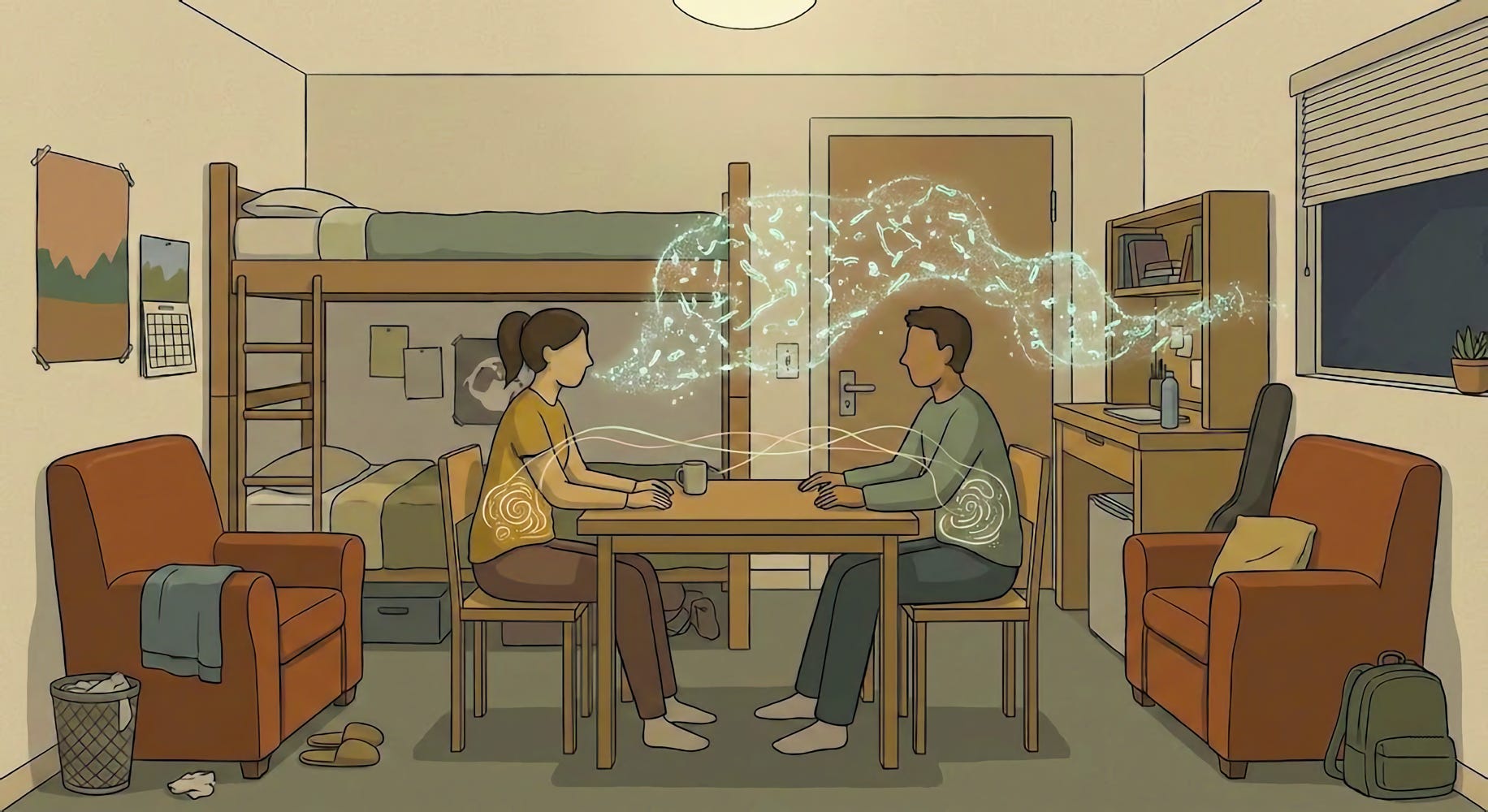
You’ve heard that your gut microbiome is shaped by your diet, your medications, your genetics. Here’s something less obvious: it may also be shaped by the genetics of whoever you live with.
A study published last December in Nature Communications ran an experiment that’s impossible to do in humans. They took over 4,000 genetically distinct rats, put them on identical diets, assigned them random cage-mates, and mapped the relationship between each animal’s DNA and its gut bacteria. The controlled conditions stripped out the usual confounds, and what remained were genes and proximity.
Genes don’t pass between individuals. But microbes do. Certain genes favor certain bacteria and those microorganisms spread through close contact. So your roommate’s genome is quietly shaping your internal ecosystem, and yours is shaping theirs. When the researchers added these indirect genetic effects to their model, the estimated total genetic influence on the microbiome increased by four to eight times for the gene-microbe links they identified.
Evergreen reminder: Rats are not humans. Translation is not guaranteed. But it’s worth digging further.
We tend to think of our genetics as a private matter: risks and tendencies that belong to us alone. This study suggests genetic influences on biology might ripple outward through social networks, without anyone’s DNA changing. If it holds in humans, our best estimates of how much genes shape disease risk have been systematically underestimated, because they never accounted for the other people in the room. [Liberty]
3. Gödel, Escher, Bach : Your Head Will Hurt (In a Good Way)

When he was fourteen, Douglas Hofstadter stumbled across a small, slim book in his local library: Gödel’s Proof by Ernest Nagel and James R. Newman. For some strange reason, the book permanently imprinted itself in his brain. Nearly two decades later, Hofstadter eventually caved and sat down to write a short pamphlet in the same spirit. What emerged was Gödel, Escher, Bach, a 777-page epic on language, art, music, and the nature of consciousness. It went on to win the Pulitzer Prize and become maybe the most unlikely bestseller in history.
Be warned, your head will hurt at times. GEB is a wild ride: incredibly experimental, cerebral, and complex. It doesn’t just explain strange loops, it keeps building little ones under your feet, until you start to feel the idea in your bones. That said, the sheer fun that Hofstadter exhibits page-to-page is so intensely unique, intoxicatingly enjoyable that you don’t even care your head is hurting. It’s one of the rare nonfiction books that captures the vitality of fiction; hell, surpasses the vitality of most fiction.
Funnily enough, similar to Hofstadter’s origin story, I came across GEB on my father’s bookshelf late in my teens. Something about the strange name and strange cover just called out to me. I picked it up, started reading, and physically could not put it down. I still remember where I was when I read it. It’s that kind of book. GEB has since been a kind of personal North Star of mine; both in terms of what I read and what I hope to one day write. It changed my perception of what I thought a book could be. Whatever your final verdict on it, Gödel, Escher, Bach will permanently imprint itself in your brain, just like Gödel’s Proof did for Hofstadter, I can promise you that. [Dylan]
📙 Gödel, Escher, Bach: An Eternal Golden Braid by Douglas R Hofstadter
4. Counterpart : A/B Testing the Whole Earth

Counterpart was cancelled after two seasons, largely because it was “a very male show” and Starz was trying to attract more women at the time (Starz’s COO admitted it in an interview). I wouldn’t quite put it up there with Deadwood in the pantheon of shows that shouldn’t have been cancelled, but it’s strong enough to deserve a much wider audience than it got.
The premise has the bones of old-school sci-fi: two parallel Earths, split apart in 1987 during an East German experiment gone wrong. They started identical, but have been diverging ever since, which means somewhere on the other side, there's a version of you that made different choices. Anyone with a scientific mindset will love the idea of A/B testing the whole planet!
There’s one portal between the two worlds, but it’s kept secret. There’s diplomacy and intrigue between the two sides, a kind of inter-dimensional Cold War. The dual protagonists, both played by J.K. Simmons (Whiplash!), work for the Office of Interchange (OI). One actor playing two versions of himself could’ve been a gimmick. It isn’t.
The show’s real topic isn’t geopolitics. It’s the question of who you’d have become if things had gone differently, and whether you could forgive that other version of yourself. [Liberty]
📺 Counterpart (2017-2019)
5. The Lover : My Fictional Character's Favorite Book

I’m about a dozen chapters into my first novel, and naturally I asked Claude for its opinion of my story. But I went further and eventually asked it what my main character’s favorite movies, music... and books, would be. I was surprised by how many things on the list I didn’t even recognize. So I asked: if I were to only read one, what would it be? The Lover, by Marguerite Duras. How I came to read this book still boggles my mind — I probably never would have picked it up myself, and I can’t think of a person in my life who might have recommended it to me. But I gave it a whirl, and what a reward it was.
The Lover is Marguerite Duras’s autobiographical novel about a teenage girl and an older man in colonial Vietnam. The circumstances are categorically off limits by today’s standards. What’s most striking is that the book is not drenched in transgression but grief. Not grief over what happened, but over the fact that it ended. Duras refuses to deliver a verdict (like Nabokov’s Lolita, another book that withholds the verdict you came looking for). She has a gorgeous ability to weave narrative into a stream of consciousness exploration of memory. The effect is a montage of moments and feelings that dance across the protagonist’s timeline. While the devil lives in the details, so does the divine.
Meanwhile, our culture sends wildly contradictory signals: a booming sex industry on one side, and plummeting fertility rates on the other. Something doesn’t seem right. Perhaps it has something to do with the fact that while modern culture is obsessed with sex, it seems to have completely forgotten about love. [Jean-Marc]
📘 The Lover by Marguerite Duras